It’s not the Justice system that’s broken – it’s the political system

Chester
Chester Borrows, head of the Justice Advisory Panel

Writing in Newsroom last week, Laura Walters discusses the work being done by the Justice Advisory Panel appointed by Andrew Little. She says the Panel has found that:

“there is widespread acceptance that New Zealand has a broken justice system”.

She says the head of the advisory panel, Chester Burrows, claims there needs to be a change of focus from punishment to healing and quotes him as saying:

“the type of changes being promised would take at least a generation to be delivered.”

Apparently, Justice Minister, Andrew Little, and National Party justice spokesman Mark Mitchell agreed with Borrows that transformative change like this would take time.

Key statistics

The notion that the justice system is broken is based on three key statistics. The first is that prison population recently hit an all-time high of 10,800 – although it may have dropped a bit since then. The second is that 50% of inmates are Maori even though they make up only 15% of the general population. The third is that rehabilitation programmes are ineffective with the result that 60% of prison inmates re-offend within two years of being released.

NZ Prison rate
Graph showing the growth of the NZ prison population 1900 to 2016

Rather than ‘broken’, the number of Kiwis in prison suggests the system is far too efficient. It has been locking up Kiwis in record numbers, currently 220 inmates per 100,000 of the general population. The reality is that New Zealand incarcerates more people than corrupt, undemocratic countries such as Honduras – which has the highest murder rate in the world but a prison rate of only 200. We also lock up more than other western democracies like Australia where the rate of imprisonment is 167 per 100,000; England & Wales (143); Canada (114); Finland (57); and Iceland (38) –  which is rated the safest country in the world and has exactly the same number of murders per head of population as New Zealand.

Solving the primary problem

So, if we solved the first problem – that there are too many Kiwis in prison – that would largely solve the other two. For instance, if there were only 5,000 people in prison instead of 10,000, only 2,500 would be Maori instead of 5,000. Similarly, even if 60% continued to reoffend, that would be 3,000 reoffenders instead of 6,000. That doesn’t mean we shouldn’t tackle institutional racism in the justice system or try to reduce re-offending, but the greatest gains will be achieved by quick-fix measures which reduce the prison population.

Once upon a time, Andrew Little would have agreed. He said he wanted to reduce the muster by 30% within 15 years. He seems to have given up on that goal. Instead of reducing the prison muster, now he wants to fix the entire justice system and claims it will take a generation – which is about 30 years.

That’s a shame – because the prison population could be easily be reduced by 30% within three years. All the government has to do is repeal the Bail Amendment Act of 2013 which led to an extra 1,500 people sent to prison on remand (i.e. not yet convicted); and allow 1,500 low risk prisoners to be released automatically half way through their sentence – instead of making them go before the Parole Board which, according to Mike Williams, has lost the plot.

The need for public support

Unfortunately, after failing to repeal the three strikes law, Andrew Little seems to have given up on amending any legislation at all. Instead, it seems he wants to change the punitive culture that Garth McVicar, the media and the two major political parties have generated in the last 20 years by talking ‘tough on crime’ – a process known as penal populism.   Instead of using legislation, it seems Mr Little now wants public support to change the public narrative – but admits he’ll have to wait 30 years to get it. This text he sent me a few days ago demonstrates his shift of focus.

Twitter - Andrew Little

Andrew Little needs to get on with it

The problem is, Little doesn’t have 30 years. He doesn’t even have 15. This coalition government has two years to run.  Simon Bridges is not doing well as leader of the Nats and so Labour may get another three years. So if Little is serious about cutting the prison muster, or reforming the justice system, he needs to get on with it.

And he’s dead wrong when he says it’s not about the legislation. The current crisis in the prison muster is a direct result of a raft of tough on crime bills passed by both National and Labour in the last 20 years;  both parties have been all too willing to jump on Garth McVicar’s bandwagon to ‘lock ‘em up and throw away the key’.

Andrew Little seems to have realised the futility of this approach; he recently referred to McVicar as ‘loopy’. But there is no doubt that the current crisis in our prison system is the direct result of 20 years of fear-mongering and scare tactics about keeping the community safe.  Now Mr Little wants to reverse course. But he can’t repeal any of these measures because Labour doesn’t even have the support of coalition partner, NZ First, let alone the New Zealand public. I rest my case. It’s not the justice system that’s broken. It’s the political system.

Kelvin Davis has a cunning plan

Baldrick
Baldrick: “I have a cunning plan!”

When Blackadder and Baldrick were in a difficult situation, Baldrick would come up with a turn of phrase which became a standing joke: “I have a cunning plan” he would say.

The Labour government is also in a tricky situation with regard to justice reform. Andrew Little and Kelvin Davis want to reduce the prison population by 30%. The fly in the ointment is NZ First which shot down Little’s recent proposal to repeal the three strikes law.

Given NZ First’s uncompromising stance on law and order, Labour is unlikely to pass any legislative proposals related to crime and punishment in this parliamentary term. But just as Baldrick used to do, Kelvin Davis and Corrections have come up with a cunning plan.

Instead of repealing the three strikes law or the Bail Amendment Act, Davis has persuaded management in the Department to alleviate obstacles in the way offenders are processed in prison. Corrections deputy national commissioner, Leigh Marsh (below), was put in charge of the project and has come up with two main strategies.

Leigh Marsh
Leigh Marsh, deputy national commissioner – the man with a plan.

Bail Support Service

One is to assist the growing number of defendants on remand apply for bail in the community instead of spending months in prison waiting for their case to come up.

Since the Bail Amendment Act was passed in 2013 making it more difficult for defendants to get bail, offenders are now far more likely to be remanded in prison. However, they may be eligible to apply for electronically monitored bail (known as ebail); the defendant has to come up with a suitable address, and whoever lives there (usually family), has to give their permission.

To apply, the offender has to write to the people in the house and ask if he can stay there on ebail. He may not know the exact address which is another obstacle. Even if he does, whoever he writes to might not bother to reply. If they say ‘no’, then the prisoner has to come up with someone else to write to.  Of course, all this assumes the prisoner can read and write – when the reality is that 70% of those in prison struggle with basic literacy.  In other words, this is a slow frustrating procedure and most of those on remand just give up and wait till their day in court.

According to Corrections deputy national commissioner, Leigh Marsh, Corrections has put a rocket under remand by creating a Bail Support Service and a bail phone App.  Bail Officers visit the prisoner the day after he is remanded in prison to assist with the paperwork, and contact the appropriate support people. They also liase with defence counsel and try to get the defendant’s bail application before a judge within a week. This has cut dramatically the amount of time that prisoners spend on remand. Once offenders get out, they get their cell phone back and the App helps them stay on track with their bail conditions.

Parole ready

Sir Ron Young.jpg
Sir Ron Young – parole board chairman

Corrections’ other new strategy is to help sentenced prisoners become ‘parole ready’. The background to this is that the Parole Board will not generally release any prisoner until he, or she, has completed a criminogenic rehabilitation programme. Often the Board insists that prisoners must do two rehab programmes before they are considered ready for release.

The problem was that until Kelvin Davis got involved, Corrections made little effort to put prisoners into programmes until they were near the end of their sentence.  That means most prisoners would end up serving almost their entire sentence, even though they became eligible for parole after completing one third.

By failing to put prisoners into programs early on in their sentence, Corrections was actively preventing them from being paroled – including low to medium risk prisoners who make up the bulk of the prison population.

Leigh Marsh says that Corrections is now making more of an effort to place prisoners into programs before their first parole hearing – something they have never done before.  As a result, in the last 12 months approximately 5% more prisoners have been released on parole.

Impact

These changes have made a significant difference.  According to Newsroom:

ImpactThe population peaked in March at 10,820 and on 3 October had dropped to 10,035 – a 7.3% fall.


Two days later Stuff reported:

“The prison population has dipped below 10,000 for the first time in more than two years”.

Given that prison numbers have been rising steadily for over 50 years, it is too early to tell whether this is just a temporary blip or part of a new trend. One thing is clear. This new approach involves a great deal more respect and humanity for offenders and a much greater commitment to due process.  Instead of chucking offenders into prison to take their chances with an unresponsive system riddled with insurmountable obstacles, now Corrections is actively trying to help offenders get out and stay out.

I have to say – that’s a novel idea – one that has never been tried before in New Zealand.

Cost savings

But wait, there’s more. It costs $110,000 a year to keep someone in prison. Since there are already 800 less prisoners, that’s a potential saving of $88 million in one year. If these initiatives had been introduced 20 years ago, the savings would have been $1.7 billion. If these initiatives continue to work and eventually cut the prison population by Labour’s goal of 3,000, that would save $330 million a year. Over the next 20 years, we would save $6.6 billion.

Even Blackadder would agree – this is a very cunning plan. It’s called common sense.

How to cut the prison population by 50% – long term solutions

Andrew little
Andrew Little wants to roll out “therapeutic courts” to treat offenders with addictions

Cutting the prison population by 30% is easy: repeal the Bail Amendment Act and allow more short-term prisoners to be released after serving half their sentence. These suggestions are discussed in How to cut the prison population by 50% – quick fix solutions.

But to get to 50%, we also need to stop putting so many people in prison in the first place. And we need to reduce the re-offending rate.

Unlike the quick fixes, some long-term solutions will require financial investment. Others, such as raising the price of alcohol will actually increase government revenues.

Increase the price of alcohol and decriminalise cannabis

Despite the endless scaremongering about methamphetamine and synthetic cannabinoids, alcohol is by far the biggest drug problem in the country.  In Alcohol in our Lives, the Law Commission said 80% of all offending is alcohol and drug related.  The Commission concluded that increasing the price of alcohol 10% (by raising the taxation component) was the single most effective intervention to reduce alcohol related harm and would raise $350 million in revenue.

It also recommended an increase in the legal age of purchase to 20, restricting the sale of alcohol in supermarkets (which now account for 70% of all alcohol sold in New Zealand), and an increase in funding for addiction and mental health treatment. The National Government ignored all these recommendations.

Decriminalising cannabis would also help keep drug users out of prison. If the Government wanted to be really bold, it could decriminalise possession of all drugs as Portugal has done.  In July this year, the New Zealand Drug Foundation released a similar policy, Whakawatea Te Huarahi. The Foundation describes this as:

“a model for drug law reform which aims to replace conviction with treatment and prohibition with regulation… under this model, all drugs would be decriminalised. Cannabis would be strictly regulated and government spending on education and treatment increased.”

This would make a big difference. In 2015, offenders with drug offences accounted for 13% of all sentenced prisoners.  So apart from a few big time drug dealers who would remain in prison, if personal possession was decriminalised, that’s another 800 people or so that could be treated in the community instead of in prison.

Increase the number of drug courts

Decriminalisation needs to be aligned with a significant increase in funding for ‘drug courts’.  Here’s how they work. When someone appears in court with alcohol or drug related offending, the judge gives him a choice. Instead of sending him to prison for the umpteenth time, if the offender agrees to be dealt with in the drug court and go to treatment, he may avoid going to prison.

The offender comes back to court every two weeks so the judge can monitor his progress. The whole process usually takes about 18 months. If the offender successfully completes everything he’s told to do, he avoids a prison sentence. Those who ‘graduate’ say this process is much tougher than going to prison.

This is a highly effective intervention. But right now, there are only two drug courts in the whole country, and they ‘treat’ only 100 offenders a year. Over the next five years, New Zealand needs to increase the number of Drug Courts to at least ten.  Justice Minister, Andrew Little, has already agreed to ‘roll them out’.  This will require a significant increase in funding for AOD treatment services in the community, but it would keep at least 500 offenders a year out of prison. If drug courts were rolled out nationwide, even more could be managed in the community.

Increase funding for reintegration services

Sending less people to prison is paramount. Reducing the risk of reoffending is equally important. Currently, within twelve months, 28% of ex-prisoners are back inside.  After two years,  41% are back in prison.  These figures have changed little in the last 20 years, despite a massive increase in the availability of alcohol and drug treatment in prison; and despite a concerted effort by Corrections in the last few years to reduce reoffending by 25%.

The problem is Corrections spends approximately $150 million a year on rehabilitation programmes in prison – on programmes that don’t work. There’s a reason they don’t work. The reality is that 15,000 people (most on short sentences) are released from prison every year. Many are alienated from family and have nowhere to live. Very few have jobs to go to. Hundreds have no ID, no bank account and struggle to register for the dole. In Beyond the Prison Gate, the Salvation Army recommended…

“that the Department of Corrections ensures all ex-prisoners are provided with six months of accommodation… and create industry schemes that will employ prisoners for … 12 months post release if they have no other employment.”

Here’s the crux of the problem. While the Department spends $150 million on rehabilitation in prison every year, in 2017 only $3 million was budgeted for supported accommodation – for an estimated 640 ex-prisoners. Until $150 million is also spent on half-way houses and reintegration services, the funding spent on rehabilitation in prison is money down the toilet.

There are many other options available. But until we have a Government with the courage to ignore the moral panic perpetuated by the Senseless Sentencing Trust over the last 20 years, our prison muster will continue to multiply; and millions of taxpayer dollars will be squandered on the dubious delusion that locking citizens away creates a safer society.

How to cut the prison population by 50% in five years – quick fix solutions

Andrew little
Andrew Little wants to reduce the prison population by 30%

In September 2017, New Zealand’s prison population hit an all-time high of 10,470, of whom 2,983 or 28% were on remand.  The background to this boom is covered in Explaining NZ’s record high prison population.

Whatever the causes, the situation is clearly out of control. The operating cost of our prison system is about $100,000 per prisoner or $1.5 billion a year.  The National Government was planning a new prison at an estimated cost of $2.5 billion. According to the new Justice Minister, Andrew Little, unless we start doing things differently, New Zealand will need to build a new prison every two or three years.

At the 2017 election, Gareth Morgan proposed reducing the prison muster by 40% over ten years. The Labour coalition wants to reduce it by 30% over 15 years. However, both Kelvin Davis, the new Corrections Minister and Andrew Little have been very vague about how they intend to achieve this. Both also seemed to think it was complicated and would take a long time.

Reducing the prison population is not difficult. The simplest approach is to repeal most of the ‘tough on crime’ legislation that has been passed in the last 25 years.  There are also some easy administrative fixes which will reduce the prison population by up to 3,000 very quickly. This article describes some of the quick fix solutions. (Also see Roger Brooking interviewed by Hilary Barry on Breakfast on this subject.)

Reduce the number of prisoners on remand

Of all the punitive legislation passed since 1980, the Bail Amendment Act in 2013 produced the biggest bump in prison numbers. This disastrous piece of legislation was introduced after the murder of Christie Marceau by 18-year-old Akshay Chand – while on bail.  However, this was not a failure of the existing bail laws.  It was the result of an inadequate risk assessment by the mental health services dealing with Chand, who was subsequently diagnosed with schizophrenia and found unfit to stand trial. He was released after a forensic health nurse advised Judge McNaughton that Chand had been taking anti-depressant medication for two weeks and could be “safely and successfully” treated in the community.

In response to the media outrage at the murder led by Garth McVicar, National passed the Bail Amendment Act making it much tougher for defendants to be granted bail. Projections by the Ministry of Justice claimed the new Bill would increase the number of prisoners on remand by less than 60.  But three years later, there are 1,500 new prisoners on remand. None of them have yet been convicted of a crime.  They’re being held in prison because a mental health nurse, not a judge, got it wrong and because National gave in to the moral outrage perpetrated by McVicar.  As a result, the Corrections Department says we need a new prison.  We don’t. We just need to repeal the Bail Amendment Act.

Release more short-term, low risk prisoners

The other quick fix is to let out more short-term prisoners early. The Parole Act defines a short-term prison sentence as one of two years or less.  Short-term prisoners don’t go before the parole board – they’re automatically released after serving half their sentence. In 2015, there were nearly 6,000 short-term inmates on a given day (although thousands more than this cycle through the prison within a 12 month period). The Board would be totally overwhelmed if it had to see all these inmates, many of whom are in prison for quite minor offences. So automatic release at the half-way mark is an administrative convenience.

Short term prisoners
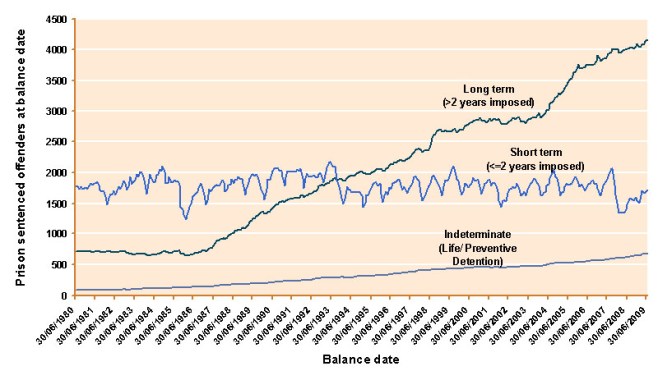
Graph showing the number of short term prisons has remained constant while the number of long term prisoners continues to rise – 1980 to 2009

A long-term sentence is anything over two years (from two years up to life).  Since 1985 ‘tough on crime’ legislation has significantly increased the number of long term prisoners (see chart above); the number of people given ‘long term’ sentences between two and three years went up 475%. In 2015, there were 765 inmates in this group, out of a total of nearly 5,000 long term prisoners.

These prisoners can only be released before the end of their sentence if the Parole Board decides they no longer pose an ‘undue risk’ to the community. Most attend their first parole hearing after completing one third of their sentence. But that doesn’t mean they get out. In the last few years, the Parole Board has become increasingly risk averse and now less than 5% of inmates are released at their first hearing – after which they serve the rest of their sentence in the community under the supervision of a probation officer.  Most long-term prisoners now serve approximately 75% of their sentence. The remainder serve their entire sentence.

So if the definition of ‘short-term’ was changed from two years to three years. That would allow an additional 765 inmates to be released automatically after serving half their sentence.  Prisoners serving four or five years could be automatically released after serving two thirds.  In 2015, there were 1,645 inmates serving between two and five years. Add this to the 1,500 no longer being held on remand and within five years, the population would be down about 3,000 – which is 30% within five years.

Prisoners also need accommodation and jobs when they get out. That requires long-term solutions, which would reduce the prison population by a further 20%. These solutions are addressed in How to cut the prison population by 50% – long term solutions

Open letter to Andrew Little & Jacinda Ardern

Jacinda
Jacinda Ardern promised “to bring kindness back”.

Jacinda Ardern, Prime Minister
Andrew Little, Minister of Justice
Parliament Buildings, Wellington

Dear Ms Ardern and Mr Little,

Your new government has taken some really positive steps in the justice arena after just a few short days in office.

Ms Ardern: On 26 October, 2017, in your first comments as Prime Minister, you said ‘I want the government … to bring kindness back’. In the Guardian newspaper read by millions  around the world, you were quoted as promising to form an “active” government that would be “focused, empathetic and strong”.

Mr Little: On your  first day on the job  as the new Minister of Justice you announced that Teina Pora’s $2.5m compensation for wrongful imprisonment would be increased to allow for inflation. That was the decent thing to do.

In the past you also voiced support for David Bain’s compensation claim. On 27 June 2013, you were quoted as saying that Ms Collins’ handling of the case had cost the taxpayer a “hundreds of thousands, if not millions of dollars, just because she’s made a mistake. And we’re all paying for it”.  You said she had acted too fast and without proper consideration of the facts, and that: “I think she’s going to be on the wrong side of this.” On 28 June you repeated your view that Justice Minister Judith Collins had “buggered it up”.

You also advocated for the establishment of an independent commission to review miscarriages of justice. On 27 October 2017, it was announced that such a body will be established under the coalition agreement between Labour and New Zealand First.  That’s good news – and long overdue.

But this is too late to help David Bain who, after 13 years in prison and another six years fighting for compensation, received $925,000 provided he agreed to cease all further legal action. The National Government stated that the payment was NOT compensation and Mr Bain would NOT receive an official apology. That was hardly a sympathetic response to Mr Bain’s drawn out legal battle for freedom and compensation.

Questions to Ms Ardern & Mr Little:

Given the compassionate response of the new government to Mr Teina Pora’s situation, will your government respond in a similarly empathic and active manner to Mr Bain. More specifically, is your new government willing to:

  • Advise Mr Bain that the payment he received is, in fact, compensation for the 13 years he spent in prison?
  • Increase the amount of compensation he received so it is in line with Cabinet guidelines of $100,000 per year spent in prison? This should take his payment from $925,000 to about $1.3 million.
  • Adjust the $1.3 million for inflation in line with the courageous Teina Pora decision?
  • Offer Mr Bain an official apology for the egregious mistakes made by the New Zealand police (as identified by Justice Ian Binnie and ignored by Justice Ian Callinan) which contributed to his imprisonment.

Yours faithfully

Roger Brooking
P.O. Box 29-075, Ngaio, Wellington

An unlikely conversation between Gareth Morgan and Garth McVicar

CartoonOne TOP party policy that hasn’t received much attention in the run up to the election is Gareth Morgan’s wish to reduce the prison population. He argues that rather than rehabilitating inmates, “prisons nurture crime”.
The Corrections Department’s own figures confirm the fundamental ineffectiveness of their rehabilitation programmes. This means that prisons don’t keep us safe either because these unrehabilitated prisoners are almost all released eventually. And prisons are incredibly expensive chewing up billions of hard earned taxpayer dollars that you could be used to fund more teachers, doctors, social workers and infrastructure.

Morgan: Garth we need to reduce the prison population by 50%. We need the money that Corrections spends on locking up prison inmates for other things like housing the homeless, treating drug addiction and improving mental health services in the community

McVicar: No, you’ve got it all wrong, Gareth. That’s what the prisons are for – to provide shelter for the homeless and take care of people with addictions and mental health problems. We need to put more of these losers in prison and get them off the streets.

Morgan: Yeah but that doesn’t solve the problem, does it? These guys don’t get any help in prison and eventually they get released on parole or at the end of their sentence. So, at the end of the day we’re no better off.

McVicar: That’s easily fixed Gareth. First, we need to abolish parole so these scum serve their whole sentence. We have to stop letting them out early. Second, we need to impose much longer sentences so hopefully these crims just die in prison. After all, life should mean life – not three years then out on parole after one year.

Morgan: But only 0.01% of prisoners have killed someone, you know, committed murder.  We can’t lock up robbers, shoplifters, drug addicts and drink drivers for life. Sentencing has to be proportionate – you know what I mean – the punishment should fit the crime. And they need help with their addictions.

McVicar: That left-wing claptrap is all well and good – but we have to lock these crims up for a long time to deter other people from drinking and stealing our stuff – otherwise everyone will be doing it.

Gareth
“Prison isn’t the solution to crime”

Morgan: But the academics say that this so-called theory of deterrence doesn’t really work – because most crims are mentally ill, brain damaged or addicted to alcohol or crack. They mostly commit crimes when they’re high as kites or drunk as skunks or to feed their addiction and the possibility of going to prison doesn’t even dawn on them.

McVicar: Don’t talk to me about academics. They’re the ones that got us into this mess by claiming that crime is the result of childhood abuse and dysfunctional parenting. It’s got nothing to do with parenting. My parents beat the crap out of me and look how I turned out. I don’t need an academic to tell me right from wrong. Crime is a personal choice made by people with no moral fibre.  Bugger this namby pamby approach, we need to use more corporal punishment on our children – that’s what turns them into real men.

Morgan: But it’s not just men Garth. There’s more and more women going to prison now as well. The vast majority of them have been sexually abused as children and because they’re psychologically damaged, they team up with abusive partners who beat the crap out of them.

McVicar: Well if you choose an abusive partner, you’re deliberately choosing to get beaten up. So, getting beaten up is a personal choice – just like crime. We have to take responsibility for our lives and stop blaming everyone else for our problems. The middle-class intellectuals have been coddling crims for way too long.

Morgan: But we can’t keep locking up more and more people Garth. Prisons are expensive. The prison population is at an all-time high. We’ve got 10,000 inmates. It costs $100,000 a year to lock up just one inmate and National wants to build another prison. When’s it going to stop?

McVicar: It’ll stop when the perverts are all locked up and the streets are safe to live in again…

Morgan: What do you mean? New Zealand is the second safest country in the world.

McVicar: That’s what I’m saying – locking up the bad guys is the only thing that works. Prisons create peace and harmony in society.

Morgan: (after a long pause with a look of bewilderment on his face) Yeah right!

‘Black hands’ – Stuff & van Beynen making money out of murder

Van Beynen
Martin van Beynen

Martin Van Beynen is a columnist for the The Press in Christchurch. He’s followed the David Bain case from the beginning and is clearly obsessed with it.  Right from the start, he was convinced David was the murderer. Twenty years later, despite the Privy Council declaration that there was a miscarriage of justice and the finding of the second jury that David was not guilty,  Van Beynen has been unable to accept reality.  And the reality is – he got it wrong.

But there’s money to be made. So in July 2017, Stuff released a 10 part podcast Van Beynen put together about the case: Why the David Bain story needed to be told one more time.  Van Beynen examines the evidence in detail – in minute detail. In the process, he loses all perspective. He’s so busy looking at the individual trees, he fails to see the forest – or that half of it is missing because of the well-documented incompetence of the Dunedin police.

Let’s not forget that during their investigation, the police allowed some crucial trees to be burnt down (eg: the house where the murders took place).   And those incest allegations against Robin Bain were fertile soil in which the trees of the forest were growing  – but the police threw them out as seedlings before they even got planted.  So Van Beynen only examines the decrepit, well worn trees that are still standing. He  only sees what he wants to see – just like the police, who at the time of the crime, turned a blind eye towards the allegations of incest.

Using these myopic methods, Van Beynen still thinks David was the murderer.  So do the police of course. One has to wonder – after all these years, why Van Beynen can’t admit he got it wrong? He has a reputation for solid investigative journalism. So why is he still in denial about the Bain case? Perhaps it has something to do with the fact that he has a brother who works for the police – the same police who destroyed half the trees in the forest.  Or perhaps its because Van Beynen works for Stuff, and this is an opportunity for them to take his obsession with the case and make more money off it.

Bill English admits his Government is a moral & fiscal failure

bill-2
Prisons are a moral and fiscal failure

In 2011, Bill English claimed that prisons were “a moral and fiscal failure” and New Zealand should never build another one. Well said – and achievable – but only if Governments stop pandering to the so-called Sensible Sentencing Trust and the moral panic manufactured by the media whenever a violent crime occurs.

Later that year, the Government set the Corrections Department a goal – to reduce reoffending by 25% (by 2017).  Perhaps Mr English thought that if reoffending declined, so would the prison population – or at least it wouldn’t go up.

In October this year, Mr English and the Government had to admit total defeat on both counts. Reoffending has been reduced a little (by about 8%) – but only in the first 12 months after completion of a rehabilitation programme.  After that, the reoffending rate is back to normal – which means 52% of prisoners return to prison within five years. The long-term reoffending rate has not changed in years.

In the meantime, the prison population has hit an all-time high and the government says it is going to build yet another prison. This increase in prison capacity is going to cost you and me, the taxpayer, an additional $1 billion. Imagine what the education sector could do with another billion dollars – more teachers, better pay, smaller class sizes, with staff satisfaction and retention improved. Imagine what the health sector could do with another billion dollars – reduced waiting lists, better access to mental health care and addiction treatment, better support for those on low incomes and a reduction in New Zealand’s escalating poverty statistics – all of which would likely lead to less crime.

We have to provide the capacity – yeah right!

Announcing his Government’s moral and fiscal failure, Finance Minister Bill English contradicted his 2011 statement about no more prisons saying: “This is something that has to be done. We have to provide the capacity.”

Phil Goff.jpgNo – we don’t. There is absolutely nothing inevitable about this increase in our prison population.  It is entirely the result of penal policies passed by both Labour and National governments in the last few years – policies which have been getting more and more draconian. In a press release in 2002, Tougher laws driving up prison population, Justice Minister Phil Goff said tougher sentencing and parole laws enacted by the Labour government would increase the prison population by over 20% in the next seven years.

This year Judith Collins said the continuing increase was due to tougher laws passed by National. She said criminals are getting longer sentences but that the muster blowout since 2014 has mostly been driven by a 40% increase in the number of prisoners on remand. That blowout stems from changes to the Bail, Sentencing and Victim’s Rights Acts.

There is absolutely nothing inevitable about this. Prof John Pratt of Victoria University would say it is entirely due to political populism – whereby politicians follow the dubious wisdom of victims groups and the media instead of taking advice from criminologists and justice sector experts.

How Finland cut its prison population

Finland is an example of what can happen when politicians listen to academics. In 2006 in Little done to break cycle of offending, Simon Collins wrote:

“Finland has cut its imprisonment rate by two-thirds in the past 50 years, with no apparent effect on the crime rate.”

He quotes Tapio Lappi-Seppala of the Finnish Institute of Legal Policy who said Finnish judges, lawyers and politicians were ashamed of their high rate of imprisonment compared with other Nordic countries which had quite low rates.

In the 1960s, on their own initiative, judges in Finland started imposing shorter sentences on a variety of offenders. In the 1970s, politicians backed up the judges with two key law changes: imprisonment for theft and drink driving were abolished and replaced by fines and ‘conditional imprisonment’ – offenders stayed out of jail as long as they did not reoffend. Then in 1994, a new sentence of community service was introduced to replace short jail terms.

The result was a dramatic drop in the rate of imprisonment from 195 down to 66 inmates per 100,000 of the population. This proves it can be done. During this same period (1960 to now) New Zealand’s rate of imprisonment has gone up and up. In 2016, it topped 200 people per 100,000 – four times higher than Finland’s. This puts us on a par with Mexico (204) and way above Australia (152), the United Kingdom (146), China (118) and Canada (114). Altogether New Zealand locks up more people per head of population than 150 other countries.

Liam Martin
Dr Liam Martin: “Its time to start making different choices.”

Attempts have even been made in New Zealand to turn this around. In Lessons from youth justice for our prison policy, VUW criminology lecturer Dr Liam Martin notes:

“It’s time to start making different choices. Our history of youth justice is a reminder we have changed paths before: in less than a decade between 1988 and 1996, we cut the number of children in state institutions from 2000 to fewer than 100.”

If we can reduce the number of children in state institutions (and the number of psychiatric patients in state care), surely we reduce the number of adults in our prison system. Spending $1 billion to increase prison capacity is an irresponsible and appalling waste of taxpayers’ money. It would be much better spent in the education and health sectors – where it would actually contribute to reduced offending.

Rise in reoffence rates ‘puzzling’ – especially to Judith Collins

Collins

According to this New Zealand Herald story, Rise in reoffence rates ‘puzzling’, the Corrections Department has told Judith Collins it is struggling to understand why reoffending continues to rise in New Zealand.

The background is that in 2011 the Government set Corrections a target – to reduce reoffending by 25% by 2017. In 2014, the Department claimed it had achieved a 12% reduction and was halfway to its target. Its progress has now fallen to 8%. The Herald says:

Corrections officials said the reversal of progress towards the target was “puzzling” because rehabilitation programmes had been producing “excellent” results… “

This is simply not true. In fact it is a blatant lie, contradicted by a statement in Appendix Two of the Department’s 2015 annual report (p 134) where it admits:

“The rates of some programmes reported are small and below the level of statistical significance…”

The reality is that eleven of the twelve rehabilitation programmes run by Corrections are producing small, statistically insignificant, results.

Corrections officials in denial

One of the basic tenets of rehabilitation involves learning to take responsibility for one’s mistakes; this requires some degree of insight and personal honesty. It is ironic that Ray Smith and his management team expect criminals to front up and take responsibility for their behaviour when he and his team are not capable of it. They are lying to the Minister and to the public.

Not surprisingly, Judith Collins has swallowed what Ray Smith and his officials are telling her hook, line and sinker. Collins said there were a number of reasons why progress had slowed…

“In particular, Corrections was now dealing with a more challenging group of offenders. This was a result of police increasingly diverting less serious cases out of the justice system. Corrections had been left with fewer first-time and low-risk criminals, and a larger proportion of people who were more likely to reoffend.”

This is also not true. The Department has always focused its rehabilitation programmes on high-risk offenders who are more likely to offend. It is only in the last few years that first-time offenders and low-risk criminals have even become eligible to attend these programmes – allowing Collins to claim that the number of offenders engaged in rehabilitation programmes is now at a three-year high. So is the prison population which, in November last year, reached an all-time high of 9171 inmates.

The fact that these rehabilitation programmes are not working should come as no surprise. Virtually the same story hit the headlines in 2006  when Corrections revealed that the Straight Thinking programme actually increased the likelihood of reoffending instead of reducing it. Simon Power was the Opposition spokesman for Corrections at the time; for months on end, he kept calling for an inquiry into the way Corrections was being run.

As a result of all the publicity, Corrections scrapped most of its programmes and designed brand new ones. One of those is called the Medium Intensity Rehabilitation Programme or MIRP.  I predicted this would make no difference in a blog in March 2012 – see The MIRP doesn’t work.  Four years later, the Department’s Annual Report shows that none of these new programmes are working.

The two broken legs analogy

one broken.jpgThe reason is obvious. Those who end up in prison tend to come from backgrounds of deprivation and abuse, and suffer from mental health problems and addictions. A useful analogy is that are emotionally and socially crippled – the psychological equivalent of having two broken legs. Rehabilitation in prison is akin to placing a plaster cast on one leg. The other leg only gets a plaster cast when the prisoner is released – in the process of reintegration.

Unfortunately, the Corrections Department doesn’t have a reintegration service. It spends $160 million a year on rehabilitation programmes but only $10 million on reintegration services – which are farmed out to non-governmental organisations. The reintegration of prisoners is generally left in the hands of volunteers.

The reality is that placing a plaster cast on one broken leg when both of them are broken is not going to help. The prisoner still can’t stand up, let alone walk on the straight and narrow path that society expects. Given the lack of resources put into reintegration, it is no wonder that the Department’s rehabilitation programmes don’t work and prisoners continue to reoffend. What is really strange is that Ray Smith and Judith Collins find this puzzling – when, in fact, it’s totally predictable.

Don’t get sick in the Otago prison – cause no one gives a shit

Being sent to prison in Otago is hazardous to your health. If you get sick, you may well die because you won’t get much help from the prison nurses or doctors.

In 2010, Richard Barriball committed suicide in the Otago prison after he was unable to access the painkilling medication he had been receiving in the community for an injury to his arm. The coroner, David Crerar, criticised Corrections for providing Mr Barriball with ‘sub optimal treatment’.

In 2011, Jai Davis died when prison nurses refused to call a doctor even though Mr Davis was admitted to the prison with internally concealed drugs (codeine and benzodiazepines).  Davis was responsible for swallowing the drugs, but David Crerar was critical that half a dozen nurses on duty that weekend ignored his deteriorating condition and none of them called the doctor.

CuttanceThe same coroner has just revealed that in 2012 Boyd Cuttance spent 48 days in Otago prison. He developed an invasive fungal infection in the brain and sought help for severe headaches 30 times during those 48 days. He was only transferred to hospital after his mother who happens to be a nurse went to see him, discovered he was ‘extremely unwell’ and demanded he be sent to hospital. He died two months later.

The coroner, Mr David Crerar, cleared Dunedin Hospital staff of any wrongdoing but found prison management, doctors and nurses were totally wrong in thinking the actions they had taken constituted ”appropriate health care”.  All they did was take a blood test and give him some panadol. Mr Crerar said Mr Cuttance’s symptoms ought to have indicated to an experienced nurse or GP that something was seriously wrong with him.

Today, the Otago daily Times reports that yet another prisoner has committed suicide in the Otago prison. It will be interesting to see what involvement he had with the prison health service before he decided to take his own life. Given the speed at which the coroner works, it’ll be another three years before we know the answer to that.

But the real question is how many more people have to die before David Crerar gets sick of molly-coddling Corrections and demands an official inquiry into the Otago prison health service. If he doesn’t, the Health & Disability Commissioner or the Ombudsman certainly should. But that’s not going to happen is it. Why? Because they’re prisoners, not human beings, and no one gives a shit. Except their families.

Corrections stats show more prison officers smoking dope than prisoners

CannabisTVNZ journalist, Ryan Boswell, wrote to the Corrections Department recently asking how many prisoners and how many officers were tested for drug use in the last two years – and how many returned positive tests.   Corrections released information to TVOne which appears to show that more prison officers are now smoking dope than prisoners.

In 2014, Corrections conducted 10,971 tests on prisoners, of which 708 were positive for drugs.  In other words, 6.4% of all prisoners tested were positive, mostly for cannabis.  In the same period, Corrections tested only 26 prison officers, of which two returned positive results. In other words, 7.7% of prison officers tested positive.

600 prison staff smoking dope?

Let’s put this into context. There are approximately 8,500 prisoners. If 6.4% out of the 8,500 are smoking dope, that’s 544 prisoners.  Corrections has a similar number of employees, about 8,000, although they don’t all work in prisons. 7.7% of 8000 is 616.  So it looks like there’s slightly more Corrections staff smoking dope than prisoners.

When TVOne ran their story, Corrections crackdown on drugs paying dividends, they didn’t mention this. They focussed on the fact that the number of prisoners returning positive drug tests has dropped dramatically.  In 1998 when random testing was introduced, 30% of prisoners were caught using. Now it’s only 6%. That’s definitely progress – of sorts. Now prisoners are using at the same rate as prison officers.

Here’s a bit more context. The 26 officers drug tested in the last 12 months were at 13 different prisons. In other words, Corrections selected only two officers at each of those 13 prisons to submit to a random test. That’s too small a sample to provide meaningful results.  If 500 tests were conducted on prison officers every year, that would provide more certainty about the percentage of staff smoking dope.   It may well confirm that about 600 officers are druggies.

Reluctance to test own staff

Chief custodial officer, Neil Beales, told TVOne that Corrections has zero tolerance for its staff using drugs – the two who returned positive drug tests either resigned or were dismissed.  If the reality is that 600 officers are smoking dope, it would be more accurate to say that Corrections has almost zero tolerance for testing its own staff.

Wiri

Instead of getting rid of staff by drug testing them, the Government has announced that hundreds of prison staff will lose their jobs when older units in Waikeria, Tongariro-Rangipo and Rimutaka Prisons are shut down in the next few months. These units will be closed because prisoners will be transferred to  a brand new 960 bed prison in South Auckland which is about to open. The Wiri prison will be run by private company Serco, and of course they need to make a profit. So Corrections is laying off its staff so that a British company can profit at Kiwis expense – a company with a reputation for  defrauding the British government, and that prison reformers want banned from bidding for Government contracts.

Corrections Association industrial officer Bevan Hanlon said moving prisoners to Wiri and closing down prison wings was, put simply, the privatisation of Corrections jobs. He was right. Labour MP, Kelvin Davis pointed out the Wiri prison cost the taxpayer $900 million and said: Private prison operator Serco will be “laughing all the way to the bank“. He was right too.

Myths about rehabilitation

New Corrections Minister, Peseta Sam Lotu-Iiga said:

“Prisoners have a much better chance of successful rehabilitation in modern facilities where they have access to education, training and employment opportunities.”

There’s a lot to be said about whats wrong with the Department’s rehabilitation programmes, but one thing’s for certain – rehabilitation has little to do with buildings old or new. It has to do with turning peoples live around – something that can only done by compassionate skilled staff – not prison officers who are stoned on the job.

Corrections cuts crime with the selective use of statistics

In July 2014 the NZ Herald revealed the police have been cooking the crime stats in Papakura. Now The Daily Blog is asking the question: Has the Government manipulated Corrections statistics as well? The answer is yes.  But this is not being done by a few rogue Corrections officers. This is a systemic practice conducted in Corrections head office.

The Department claims it is focused on reducing reoffending and the diagram below taken from its website suggests that in April 2013, re-offending was down by 9.3% over the previous two years. The Department says it is on target to reduce reoffending by 25% by 2017.
When the government announced the goal of 25%, they said: “This will mean 600 fewer prisoners re-imprisoned one year after release, and 4,000 fewer offenders reconvicted within a year of beginning their community-based sentence.”

But the latest Corrections report (2013) on Trends in the Offender Population, effectively contradicts most of the Government’s claims about reduced reoffending.

Prison numbers

The report shows there has been no drop whatsoever in the number of people in prison (see graph).  In fact the number of sentenced prisoners has gone up dramatically – by 166% since 1983.Prison numbers

The best that Corrections could claim about this graph was that “From 2010 there has been a flattening in the sentenced prisoner population.”

Looking at it more closely reveals that the rate of increase also ‘flattened’ between 1983 and 1987; between 1992 and 1995; and between 1999 and 2003. After each of these ‘flatlines’, the muster continued its inexorable rise.

Offenders in the community

In regard to offenders on community-based sentences, the increase has been even more dramatic. The report says: “The number of offenders starting a new community sentence during 1983 was 14,407. This increased by 219 percent, to 48,379, in 2010.”  As with prison numbers, the overall trend is up, not down.Community numbers

But Corrections claims that: “The number of offenders starting a community sentence each year has decreased markedly since 2010. Between December 2011 and December 2013, re-offending has reduced, equating to 11.7% progress towards the target of reduced re-offending by 25 percent by 2017.” (See graph)

Sure, there has been a small drop in the last two years, but it is far too soon to determine whether this is anything other than a temporary dip in the upward trend. The report shows there was a similar drop between 1994 and 2000 – followed by a rapid rise to a new peak in 2010. Corrections’ exaggerated claims about the dip in the last two years are premature; they ignore the long-term upward trend in which the dip may be just a natural variation.

Selective statistics

In fact the dip is not natural. It’s entirely manufactured – by the selective use of flawed statistics.  To make it look like reoffending (by those on community based sentences) is down, Corrections only includes statistics of those who reoffend within 12 months from the start of their sentence, rather than within 12 months from the end of their sentence.  That’s ridiculous.  It’s like measuring the reoffending rate of prisoners while they are still in prison, with almost no capacity to commit further crime. No wonder the reoffending stats are down.

A more useful analogy is to compare reoffending rates with the survival rate of cancer victims. Measuring  survival from the start of chemotherapy or radiation treatment would not tell us much.  It’s only after treatment is complete, assuming the patient survives, that its effectiveness can be evaluated. This is done by measuring survival rates five or even ten years later. 

Short term snapshots

The same applies to criminal reoffending.  The reality that the longer a recidivist offender is at large in the community, the greater the chance he will eventually reoffend. A more detailed analysis conducted by Corrections (Reconviction patterns of released prisoners: A 60-months follow-up analysis) shows that approximately 26% of prisoners reoffend and are re-imprisoned within 12 months of release. But after five years – 52% are back in prison.  In other words, approximately half of all ex-prisoners who subsequently reoffend manage to survive in the community for more than 12 months before they commit another crime and go back to prison. But Corrections is not counting these crimes.

What this means is that the statistical data that Corrections is using to prove it’s on track towards the 25% goal comes from short term snapshots and is therefore incomplete and misleading.  For those on community based sentences the snapshot is so short, it begins at the start of the sentence while the offender may still be on home detention. This is a cynical and deceptive use of statistics which fails to provide an accurate or realistic picture of criminal behaviour in New Zealand.

Judith Collins’ staff censoring wikipedia articles on justice issues in NZ?

Earlier this year, I was interviewed by Kathryn Ryan on Nine to Noon. This was in response to revelations in the NZ Herald that the police have seized nearly $150 million worth of homes, cars, boats, cash, jewellery and other valuables under the Criminal Proceeds (Recovery) Act.  When the legislation was passed in December 2009, the Government said the seizures would be used to fund additional alcohol and drug treatment for criminal offenders. Four years later, no money has been made available.

RadioNZ wanted to interview the Minister of Justice,  Judith Collins, to ask her why none of the money had been passed on. She wasn’t available so they interviewed me instead. After the interview, the producer came up to me and said that someone from Judith Collins’ office had made it very clear to them that, even though she was not available, Collins did not want them to talk to me. When the producer asked her why, Collins said it was because she didn’t approve of articles I had edited on wikipedia about the New Zealand justice system.

Banned from editing Wikipedia

I found it hard to believe that Judith Collins would really be concerned about anything on wikipedia – until I found edits being made by someone calling herself JC press sec. Most editors on wikipedia use pseudonyms – but ‘JC press sec’ – that was just too obvious. Then there’s Clarke43. Whoever he (or she) is, Clarke43 has also done a lot of editing on the Judith Collins page on wikipedia and has systematically deleted much of the material I contributed to other articles. On a personal discussion page (known as a Talk page) Clarke43 wrote: “I don’t feel for the sake of anyone who uses wikipedia that we can leave some of these pages in the state they are in now.” Is Judith Collins using taxpayers’ money to get her staff to edit wikipedia articles to her liking?

Then I got banned from editing wikipedia altogether. Shortly after that most of the pages that I had contributed to were shredded. An article I wrote on Legal Aid in New Zealand was shortened from this comprehensive version to this short stub. A detailed article on the Sensible Sentencing Trust and its links with National and the Act Party was shortened from this to this.  Substantial cuts have also been made to articles about the New Zealand Police, the Department of Corrections, the Independent Police Conduct Authority, the Government Communication Security Bureau, Crime in New Zealand, Corruption in New Zealand, the Ministry of Justice, the Accident Compensation Corporation and David Bain. For obvious reasons, these are all articles that Judith Collins might have an interest in.

Banned by prison manager

It looks like someone is trying to shut me up.  Even the manager at Rimutaka prison is having a go. Here’s the story.  I’ve been going into Rimutaka prison for 15 years. Normally when I have to see an inmate, I make an appointment and then show my driver’s licence at the gatehouse. About three months ago, one of the officers on duty commented that because I was a regular visitor, I should apply for a Special Visitor’s pass. So I did.

This should have been a routine matter. But to my surprise, about six weeks later I received a letter from Chris Burns, the Prison Manager. He said my application for the Special Visitors ID was declined because of a story which appeared in the Upper Hutt Leader in which I criticized the Department for wasting $13 million on cell phone blocking technology. The article pointed out that the number of cell phones confiscated from prisoners had more than doubled since the technology was installed. It contained this brief quote: “Drug and alcohol counsellor Roger Brooking, who helps inmates at Wellington prisons, said jamming technology had not stopped prisoners from using cellphones in prison and described the project as a ‘failed strategy’.”

I thought New Zealanders had freedom of speech – according to the Bill of Rights we do.  But Judith Collins and Chris Burns don’t seem to think so. Mr Burns declined my application for being “critical of the way the Department operates in regard to stopping prisoners using cell phones in prison”.  How bizarre. But guess what. Information about the failure of the cell phone blocking technology was then deleted from the wikipedia page about the Corrections Department. This is called censorship!

But what I really want to know is – how does Judith Collins know what I’m doing on wikipedia? I don’t use my real name – I use a pseudonym. Does that mean the GCSB is watching me? No that’s illegal – and surely the GCSB would never break the law. Yeah right!

Read more at  Suppressing free speech and editing Wikipedia. Is that why we pay taxes, Mrs Collins?

Join the discussion at The Standard: Collins sanitising wikipedia

Untested substances – Dunne to death by refusal to spend $5,000

Associate Health Minister Peter Dunne has adopted a tough approach towards ‘untested substances’ found in synthetic cannabis, but a hands-off approach towards more dangerous Class B drugs found in alcohol. On October 3rd, he banned three synthetic cannabis substances and instructed health officials to investigate and test these new products.

This means 19 different substances are now banned under Temporary Class Drug Notices which became law in August – with 43 products containing these substances already removed from the market. Mr Dunne issued this staunch statement:

“If testing shows that they contain substances already banned, they will be gone. If it shows they contain new untested substances, I will put in place the necessary Temporary Class Drug Notices to deal with it. I have removed 43 products already; if I have to remove another 43, so be it.”

“If the industry thinks they can get around the law by changing a couple of ingredients, repackaging, re-branding and back to business the way they always have, then they have seriously misread the scope and potency of this law. We are not letting them make their profit by plying young New Zealanders with substances that are unproven and potentially unsafe. The game is over. It is just that it has not clicked for some of them yet”.

Wine also contains ‘untested substances’

In the same week, Professor Doug Sellman and Dr Geoffrey Robinson announced that medical research undertaken in the UK has come to light showing that alcoholic drinks made through the fermentation of white and red grapes contain small amounts of a drug known as Fantasy. Fantasy is the street name for gamma-hydroxybutric acid (GHB) and related substances. It is scheduled as a Class B prohibited drug – considered to be of high risk to public health.

“The UK finding that wine contains Fantasy raises the intriguing situation that New Zealand wines contain a prohibited Class B drug” said Dr Geoff Robinson, who is one of the authors of New Zealand research which equates the risk that alcohol poses to society as similar to the risk posed by GHB.

Prof Sellman concurs: “Given that there are no specific data on wine sold in New Zealand, it would be appropriate for the Government to sponsor such research. Little is known about the specific synergistic effect of ethanol mixed with Fantasy and at what doses the mixing of these drugs is important. The situation we are facing with the existence of two Class B drugs in wine – one legal and sold in supermarkets, the other illegal and associated with severe legal sanctions – highlights the irrational and inconsistent drug laws we have in New Zealand”.

Testing only costs $5,000  

Given his staunch attitude towards the risks of ‘plying New Zealanders with substances that are unproven and potentially unsafe’, theoretically Mr Dunne has little choice but to ban wine immediately and have it tested. Of course that’s not going to happen; wine will never be banned.

But if it contains GHB and no testing is done, this makes a mockery of Mr Dunne’s tough talk. Alcohol kills over 1,000 New Zealanders a year and Mr Dunne refuses to even get it tested to see if it contains an illegal Class B drug. Meanwhile he bans these synthetic cannabis products which have yet to kill anyone.
At the very least, the testing needs to be done. It only costs $5,000 – a cost the Government is prepared to bear to test synthetic cannabis.

Suppose that wine was tested and found to contain GHB. Would Mr Dunne be true to his word and prevent wine growers from supplying ‘New Zealanders with substances that are unproven and potentially unsafe.’ Of course not. The Government doesn’t to spend $5,000 to test wine because it doesn’t want to know the answer. It would all be too embarrassing and so this research will never be Dunne.