Sweden has Greta Thunberg – New Zealand has Ollie Langridge

Greta
Greta Thunberg – flashing a rare smile

Hopefully, just about every Kiwi knows who Greta Thunberg is. In case you’ve been hiding under a rock, she’s the schoolgirl in Sweden who took time off class to draw attention to the climate crisis. She protested outside the Swedish parliament with a sign reading ‘School strike for the climate’  kicking off a strike by school kids around the world. What’s remarkable about Greta is she realised our house is on fire at the age of 15, and is trying to put it out all on her own. The response to her courage and conviction has been extraordinary, from around the world.

Ollie
Ollie Langridge outside Parliament – head down -demonstrating the message is more important than the man

New Zealand now has a lone parliamentary protester as well. His name is Ollie Langridge. At 55, he’s a few years older than Greta and has a wife and six children. Langridge began his protest two weeks ago after the UN Biodiversity Report was released, which warned Earth was in the middle of a mass extinction. He said he was motivated by the fear he felt for his children’s future and was going to stand outside parliament, seven days a week until the Government declares a climate change emergency.

Is there really an emergency? The World Meteorological Organisation advises that levels of greenhouse gases are now higher than they have been in the past 800,000 years.  The result is global warming. Petteri Taalas, secretary general of the World Meteorological Organisation says:

“The last time the Earth experienced a comparable concentration of CO2 was three to five million years ago, when the temperature was 2-3C warmer and sea level was 10-20 metres higher than now.”  

If that happens, quite a few cities around the world will be under water. That should put out a few fires – but a lot of people are going to drown first.

Greta Guardian
Greta – Guardian of the planet Earth?

Let’s check out a few other comments that Greta has made about this. At a TEDx talk in Stockholm, she said

“For those of us, who are on the (autism) spectrum, almost everything is black or white. We aren’t very good at lying and we usually don’t enjoy participating in the social games that the rest of you seem so fond of… There are no grey areas when it comes to survival. Either we go on as a civilization or we don’t.”

In October 2018, she addressed the ‘Declaration of Rebellion’ organized by Extinction Rebellion opposite the Houses of Parliament in London. She said:

“We’re facing an immediate unprecedented crisis that has never been treated as a crisis and our leaders are all acting like children. We need to wake up and change everything.”

At the COP24 United Nations climate change summit on 4 December 2018:

“Our civilization is being sacrificed so that a very small number of people can continue making enormous amounts of money. Our biosphere is being sacrificed so that rich people in countries like mine can live in luxury.”

Greta looking serious
Greta looking serious – go girl

Speaking to the financial elite at Davos on 23 January, 2019:

“I don’t want you to be hopeful. I want you to panic. I want you to feel the fear I feel every day. And then I want you to act. I want you to act as you would in a crisis. I want you to act as if the house was on fire – because it is”.

On 21 February 2019, Greta spoke at a conference of the European Economic and Social Committee about the need to keep global warming below two degrees centigrade. She said:

“If we fail to do so all that will remain of our political leaders’ legacy will be the greatest failure of human history.”

In Berlin in March 2019, she talked about the school strike:

“We live in a strange world where children must sacrifice their own education in order to protest against the destruction of their future – where the people who have contributed the least to this crisis are the ones who are going to be affected the most.”

At an April 2019 meeting at the European Parliament in Strasbourg with MEP’s and EU officials, she said if politicians were serious about tackling climate change, they would not spend all their time…

“talking about taxes or Brexit…  If our house was falling apart, you wouldn’t hold three emergency Brexit summits and no emergency summit regarding the breakdown of the climate and the environment.”

That’s Greta for you – blunt and to the point.  She may have started her protest alone, but not anymore. She’s got millions of supporters around the world.

On the other hand, Ollie Langridge has hardly said a word. So far, his is a silent protest. But he’s posted a lot of photos on Instagram. And you know what they say: one picture is worth a thousand words. So if you agree with Greta and Ollie that ‘the world is on fire’, head on down to parliament  and get your picture taken with him. Help Ollie persuade the Government to declare a climate emergency.

Jacinda
Prime Minister, Jacinda Ardern,  now has an opportunity to show the world real leadership

What will that achieve? Possibly very little. But it would demonstrate to the world that New Zealanders care about the survival of the entire planet, not just Kiwis murdered in a mosque.  Jacinda Ardern earned enormous international kudos for her compassionate response to the Muslim community after those shootings. She has the world’s respect. If she now declared a climate emergency, people would listen to her as well as to Greta. And then she could take a picture with Ollie.

Brenton Tarrant – the only justifiable police pursuit in the last ten years

In response to the murder of 50 Moslems by Brenton Tarrant last week, the Government has banned semi-automatic rifles in New Zealand – a decisive response to prevent any future loss of life with such weapons. Tarrant’s homicidal rampage was brought to an end after two police officers tracked him down fleeing from the Linwood mosque in his car.  According to the police his intention was to continue his killing spree elsewhere.

By some strange coincidence, the two officers had been attending a training session earlier that day on how to stop armed offenders.  They pursued Tarrant, rammed his car off the road and arrested him. The two officers deserve a medal for risking their lives and preventing further bloodshed.

79 deaths in police pursuits since 2008

On the chaseGenerally, police pursuits in New Zealand do not involve such serious crimes or such dangerous offenders. Since January 2008, police have pursued over 30,000 fleeing drivers leading to hundreds of accidents and 79 deaths, nearly half of whom were innocent victims.  The number of pursuits and the number getting killed is growing every year. But the reality is that the vast majority of the 30,000 offenders pursued by police posed almost no risk to the public – until the police started chasing them.

So many Kiwis are dying that police pursuit policy is almost permanently under review. Coincidentally, the same day that Tarrant went on his rampage, the IPCA completed its sixth review publishing a 143 page document: Fleeing Drivers in New Zealand.

The IPCA found that:

  • 35% were stopped for a driving offence for which they would not have been arrested
  • 15% were merely ‘suspected of offending’;
  • 14% were stopped for ‘suspicious behaviour’;
  • 9% stopped for an arrestable driving offence;
  • 6% were simply routine stops.

The review recommended better training and more oversight for police but no change to the pursuit policy. Police Commissioner, Mike Bush, claimed the review relieved the police of any responsibility arguing…

“the review has shown that our staff generally manage fleeing driver events well…”

Nash
Police Minister Stuart Nash: “No need for wholesale changes to pursuit policy”

Police Minister Stuart Nash said the report showed there was no need for “wholesale changes” to police pursuit policy. Judith Collins and Mike Bush claim that when drivers flee, the police have no choice. They worry that if police don’t pursue, criminals will get away scot free and that more people will take off when apprehended.  Collins argues that the police cannot “give over the roads to criminals?”

But research by the FBI has found that…

“if the police refrain from chasing all offenders or terminate their pursuits, no significant increase in the number of suspects who flee would occur.”

All the police have to do is take down the car’s registration and then pay the driver a visit first thing in the morning when the adrenaline rush is over. Only a quarter of pursuits involve stolen cars, so most of those who flee would still be caught.

Clive
Clive Matthew-Wilson

Who’s the adult in the room?

These dubious death-denying justifications by those responsible for police policy ignore some fundamental realities – that nearly half of the dead are teenagers and according to US research, 42% are innocent bystanders.  Road safety campaigner, Clive Matthew-Wilson notes that it’s pointless expecting teenagers to behave sensibly when stopped by police.  He says:

“The simple fact is: the part of the brain that allows an adult to make rational decisions doesn’t form properly until the early twenties. That’s why teenagers tend to make impulsive decisions that often end badly. Given that teenagers aren’t going to stop and think, it’s up to the cops to stop and think, instead of letting adrenaline rule their decision-making process.”

Australian road safety campaigner, John Lambert, agrees. He characterises police chases as…

“basically the most hazardous activity you could possibly undertake on roads legally… It’s a total contradiction for police to be engaging in them when they’re supposed to be improving road safety. The fatality rate for pursuits is 3,500 times higher than for normal travel.”

Police pursuits banned in Australia

Doug Fryer
Doug Fryer: “fleeing drivers do not get away with it”.

In 2009, the Queensland state government banned all police pursuits unless there had been a murder or there was an imminent risk to life. Since this policy was introduced, not one person has died in a police pursuit. The Australian state of Victoria has a similar policy. The former head of road policing in Victoria, Doug Fryer, rejected the idea that the state’s cautious pursuit policy meant criminals ‘got away with it.’

“We would far prefer to drag an offender out of bed at six o’clock in the morning than try to drag them out of a car after a crash.”

If this policy had been in place in New Zealand, not one of the 79 people who have died since 2008 would have been pursued – because not one had committed a serious crime which justified the pursuit.  These were unnecessary and totally avoidable deaths.

So who’s responsible?

Writing in The Spinoff last year, Toby Manhire agreed that police chases are inherently dangerous but went on to argue that…

“a rush to assign blame for deaths in police chases can only distort the important discussion around a pursuit policy that should put human life first.”

This not only minimises, it completely ignores, the contribution of the police to this carnage on our roads.  We need to name, ‘blame’ and shame the police because it’s their policy that’s directly responsible for the pursuits that lead to these deaths.

The reality is that until the cause of the problem is correctly ‘named’, no one can be held to account.  If we don’t specify and identify the problem – police pursuit policy – inevitably there will be more phony reviews leading to more platitudinous recommendations about better police training and oversight.

It’s a shame it took a massacre before the Government was persuaded to take decisive action on semi-automatic weapons.  In the meantime, police pursue over 3,000 drivers a year – and 79 people have died. How big will this massacre be, and how long will it go on before the Government takes decisive action on that?

Prison population bounces back up to 10,000 – again

Kelvin
Kelvin Davis had a ‘cunning plan’ – that is no longer working

The prison population is still rising and is now over 10,000 – again.  In February last year, the muster hit an all-time high of 10,700.  Towards  the end of the year, it dropped to 9,700 but is now back up again.

At the peak, Andrew Little and Kelvin Davis announced that Labour wanted to cut the prison population by 30% in 15 years – otherwise we would need another prison

The media were all over the story. One NZ Herald headline read: Govt wants to axe new prison and lower prison muster. This was a reference to the new prison that the National government had been planning to build to cope with the blowout.   The Otago Daily Times trumpeted: Little lays out plan to cut prison population.   Stuff said: Government aims to cut prison population and fix ‘abnormal’ system.

Andrew little
Andrew Little – yet to pass any legislation to reduce the prison population

In an attempt to reduce the length of prison sentences, Andrew Little made an aborted attempt to repeal the onerous three strikes law. This was shot down by NZ First which refused to play along with its coalition partners. Then Kelvin Davis stepped into the breach. He offered temporary relief telling Corrections management to make administrative changes which would cut prison numbers without having to change the law. Writing in the Spinoff, Roger Brooking wrote: Kelvin Davis has a cunning plan to cut the prison population – and it’s working.

This helped a bit. In December last year the muster dropped to 9,700. Writing in Stuff, Laura Walters observed: Prison population drops by seven per cent in six months, system crisis averted. But administrative changes were never going to cut the mustard – or the muster. In order to reduce the prison population by 30%, the Government needs to make substantive legislative changes to reduce the revolving door that our prisons, and our justice system, have become. In another Spinoff article Brooking described How to cut the prison population by 50% in five years.

Government PR campaign

Embarrassed by his aborted effort to repeal the three strikes law, Andrew Little was in no mood for additional attempts at legal amendments. Instead, Labour launched a massive publicity campaign designed to win the hearts and minds of the public that the entire justice system needed to be reformed.

Chester
Chester Borrows – implementing a impressive PR performance on behalf of the Labour Party

It began with a criminal justice summit held in Porirua in August last year which the government called “the start of a conversation.” This was followed by the appointment of a panel led by former National MP, Chester Borrows. The panel held a series of meetings up and down the country, to which the public were invited to give their opinions on how New Zealand could develop a Safe and Effective justice system. Andrew Little subsequently made remarks in the media that New Zealand’s entire justice system was broken. I beg to differ. It’s not the Justice system that’s broken – it’s the political system. In the last 30 years, political parties of both persuasions have competed with each other to pass tough on crime laws which are directly responsible for the dramatic increase in the prison population.

One of those laws was the Bail Amendment Act passed in response to the murder of Christie Marceau in 2011.  See How the murder of Christie Marceau led to 1,500 more people in prison. This piece of legislation more than doubled the number of Kiwis being held in prison on remand.

Now that prison population is over 10,000 again, the number on remand is at an all-time high. In response to an OIA, Corrections advises that on 28 February this year, the prison population was 10,015 of which 3,421 were on remand.  That’s 34% of the total. In other words, 34% of prisoners in New Zealand have yet to be convicted of a crime.

Innocent3What happened to the fundamental legal principle:  Innocent until proven guilty? Perhaps Andrew Little is right – our justice system is broken – we lock up way too many people who have yet to be convicted of a crime. Isn’t that what third-world dictators, communist countries and authoritarian, anti-democratic regimes do?
More people killed by drink drivers under the limit than over it

JAGenter
Julie Anne Genter wants a zero road toll but says it will take decades to reduce it

In 2017, 378 people died on New Zealand roads. In June last year, the Automobile Association followed up with a media release claiming “We now have more crash deaths where people test positive for a drug than (test positive for) alcohol”.

This statement was simply not true. In fact, twice as many deaths were caused by drink drivers than drivers under the influence of (other) drugs.

The AA got its figures by making an OIA request to the New Zealand Transport Authority. NZTA’s response stated that in 2017, out of 378 deaths, 79 people died in drug-related accidents and 70 people were killed by drink drivers who were over the legal limit (or who refused to supply a sample). The point to note here is that the AA didn’t ask NZTA how many people were killed by drivers under the influence of alcohol; they asked how many were killed by drivers over the legal limit.

Based on this response, AA mistakenly concluded that drugged-up drivers were killing more people than drink-drivers.

Fake news

The media bought this erroneous conclusion hook, line and sinker. Stuff headlined the story: Drug-impaired drivers now involved in more fatal crashes than drink-drivers. The Herald said: Automobile Association study finds drugs cause more fatal crashes than alcohol. The misinformation even made it to an international audience after the Guardian agreed: New Zealand drug-driving deaths surpass drink-driving toll for first time. None of these media did any fact checking.

All of these stories were, in Trumpian vernacular, ‘fake news’ – because the AA forgot to ask how many people were killed by drink drivers who were under the legal limit in addition to those who were over it. So I asked NZTA the question. They then disclosed that, in fact, 154 people were killed by drink drivers in 2017. This is almost double the number killed in drug-related accidents. See the NZTA’s response to one of my questions below:

Question 10
Answer by NZTA to OIA question: how many people were killed by drink drivers who were under the legal limit in 2017?

The AA used their dodgy data about drug deaths to argue that police should be given saliva testing kits to tackle what they called this ‘silent killer’. A spokesperson for the AA, was quoted as saying:

“The AA has called drugged driving a silent killer on our roads for years and these latest figures confirm how prevalent drugs are in fatal crashes.”

There is no doubt that the number of deaths on the road related to drug use is rising. However, it is still nowhere near the number killed by drink-drivers.

Remarkably, the figures also show that slightly more people were killed by drink drivers under the legal limit (80) than were killed by drivers over the limit (74). What this suggests is that the decision to lower the legal limit from 400 micrograms of alcohol per litre of breath to 250 micrograms in 2014 has had no impact on the road toll – which, in fact, has been going up for the last six years (see chart).

Road deaths
Alcohol & drug use contributes to over half of all road deaths

In 2017, 154 alcohol related deaths plus 79 drug related deaths suggests a total of 233 people were killed by drivers under the influence of alcohol or drugs. Deducting 21 cases where the driver was under the influence of both alcohol and drugs, that’s 212 or 56% of all road deaths that year. Because the AA has been misinterpreting the data for years, it mistakenly claims on its website that alcohol and drugs contribute to only one third of deaths on New Zealand roads.

A zero solution

This leads to an obvious, but politically unpalatable, policy recommendation. If we want to cut the road toll, we need to cut the legal limit for adults to zero – just as we did for teenagers in 2011. This might seem radical but the idea is even supported by those who make a habit of drink driving. At the Make A Plan (MAP) programme for repeat drink drivers in Wellington, participants are asked why they chose to drive after they had been drinking. Often they say: “I thought I was alright to drive”.

In other words, although they had been drinking, they didn’t feel drunk; they were unable to judge whether or not their drinking may have put them over the limit. Participants generally agree that if the limit was zero, the situation would be crystal clear and it would be much easier to make the decision – one drink and they would not be allowed to drive.

Obviously, this would not stop everyone. There are plenty of ‘bloody idiots’ who just don’t care. But for the generally law-abiding citizens among us, legal clarity is helpful. If you intend to go drinking, don’t drive. Such a move would demonstrate the Government was serious about the audacious target of zero deaths on New Zealand roads set by Julie Anne Genter in April 2018. Remarkably, in January 2019 Ms Genter changed tack 180 degrees and said it would be many decades before the road toll would be significantly reduced. It seems like she’s given up.

I know something that might help. Reduce the legal limit to zero. Any road safety strategy with a higher than zero alcohol limit has zero hope of achieving zero road deaths.

Public reaction to murder of Grace Millane racist, sexist & politically dangerous

Grace Millane

New Zealanders like their murder victims to be young, attractive, female – and white. When they are, we make a real fuss. Look at the publicity currently generated by the murder of 18-year-old Christie Marceau in 2011 and 22-year-old British backpacker, Grace Millane, just two weeks ago. Here’s just a few of the recent headlines: Grace’s legacy – Prominent women challenge men and Govt and Senseless killing’ – Grace’s death was like my daughters.

Prime Minister, Jacinda Ardern, felt it necessary to make a national apology claiming All New Zealanders ‘will feel heartbreak for that family’. The Guardian summed it up claiming that Grace Millane murder prompts outpouring of grief in New Zealand.  

‘Missing white woman syndrome’

It’s intense. Writing on Stuff, Alison Mau pointed out that ‘plentiful pictures of gorgeous Grace were available’ in this plethora of publicity and implied that all this attention is inherently racist. She noted that social scientists call it ‘Missing White Woman Syndrome’ defined by…

“the media’s undue focus on upper-middle-class white women who disappear, with the disproportionate degree of coverage they receive being compared to cases of missing men or boys, women of colour, and women of lower social classes.”

Mau reports that in Western countries like New Zealand, numerous studies reveal “viewers will stay glued to the set to hear endlessly about young, photogenic missing women – but only if they’re white” and can be depicted as “innocent” and “angelic”.

Mau makes the point that Grace is the 15th woman to be murdered in New Zealand this year.  But none of the other murders acquired anywhere near the same amount of attention – bearing in mind 31% of homicide victims are Maori and 62% of victims are male.  Paul Little argued in Grace Millane case highlights a terrible double standard that:

“Grace Millane and her memory deserve every tribute, and her whānau deserve every iota of sympathy that comes their way. But so did those other victims… we act as though all lives aren’t created equal.”

Christie
Christie Marceau – innocent & angelic

The murder of Christie Marceau

The media’s response to the murder of Christie Marceau was equally intense. She was also young, attractive, female and white. Christie was killed by Ashkay Chand who two months earlier had already threatened to rape and kill her. Much of the subsequent outrage, driven by Garth McVicar, was directed at the judge who allowed Chand out of prison on bail. McVicar even started a campaign to have the bail laws amended so this would never happen again.

Sure enough, two years later, National passed the Bail Amendment Act which doubled the number of prisoners on remand in three years and created a crisis in prison capacity. In response, Justice Minister, Andrew Little, said Labour wanted to reduce the prison population by 30%.

One of the concerns about the Grace Millane case is that Google and British media breached the temporary suppression order and named the alleged perpetrator. Peter Williams claimed the internet has compromised justice and wondered whether he can get a fair trial. Williams also found it totally inappropriate that the Prime Minister made a public apology to the Millane family. He wrote:

“Has a New Zealand political leader ever made such an emotional comment about a homicide victim before? More pertinently, why would the Prime Minister think it appropriate to comment on one homicide victim in a week when there were at least three other homicides in the country? Politicising a homicide case is not appropriate. Do it for one, and you really should do it for all.”

And not just for the families of attractive, young, white females. Each year approximately 50 people are murdered in New Zealand – giving us one of the lowest homicide rates in the world. No one in the Government has ever apologised to any of these families – not even to the family of Christie Marceau where a judge was (incorrectly) accused of being at fault.

Media commentator, Jim Tucker, thinks the outpouring of outrage is because Grace’s murder has embarrassed us overseas.  It seems we’re so embarrassed that a …

“cohort of prominent women including former Prime Ministers Helen Clarke and Jenny Shipley signed an open letter to the men and government of New Zealand and submitted it to the Prime Minister’s office. The letter stated that New Zealand had some of the worst statistics for violence against women in the OECD and listed actions each party could take to make our country a safer place.”

Of course, different countries define and report violence using a variety of methodologies so it is not clear how reliable these statistics actually are. Nevertheless, in yet another headline, the Government says it is listening’.

That’s a worry. Ever since the law and order referendum initiated by Norm Withers in 1999, New Zealand has been listening to populists with a penchant for punitive legislation. Just this year, a Bill was introduced requiring judges to impose a six-month prison sentence on anyone who attacks a paramedic or other first responder. At the beginning of December, new legislation came into effect penalising attempted strangulation. Both of these will put more people in prison.

Why is this politically dangerous?

It’s dangerous because it risks escalating the pathetic competition between political parties to be tough on crime which has gone on for the last 20 years – and because it will undermine Andrew Little’s aborted attempts to reduce the prison population.

So how will politicians respond to the murder of Grace Millane? Chances are some right-wing MP will try to re-introduce a private member’s Bill advocating the death penalty for the murder of attractive, young, white women. Further down the track, some other MPs could decide to hang the killers of less attractive, young, white women – or even wrinkled, older, white women. That would keep the prison population down.

Gavin Hawthorn: sending him to prison does not make us any safer

Gavin.png
Gavin Hawthorn: 13 convictions for drink driving

News that Gavin Hawthorn has recently been convicted of drink driving yet again has caused oodles of outrage in the media. Hawthorn has already killed four people in two separate accidents. In 2004 he was convicted of manslaughter over the death of his friend Lance Fryer and sentenced to 10 years in prison. He was released in 2013 and has now been caught drink-driving again – for the 13th time. On this occasion Judge Johnston sentenced him to six months home detention and disqualified him from driving for two years.

The headlines were horrified. Stuff stated it like this: Recidivist drink-driver Gavin Hawthorn convicted again, leading to call for permanent driving ban. Newshub harrumphed that it was ‘Appalling’: Porirua man Gavin Hawthorn escapes jail after 12th drink-driving conviction. The Herald highlighted: NZ’s worst drink driver caught drunk behind the wheel again. Duncan Garner was especially incensed arguing that:

“This judge has failed to keep us safe as New Zealanders. We’ve been let down by his profession once again. He has let us down, now we are in harm’s way.” He went on to say the case was an example of why the public “have little confidence in the justice system”.

Blaming judges is misguided and myopic.  This is what Garth McVicar and the senseless sentencing trust have been doing for years. All that has achieved is a burgeoning prison population and a crisis in capacity. At $100,000 per prisoner, per year and a reoffending rate of 60% within two years of release, clearly this is a failed strategy – and a massive waste of taxpayer money.

Keeping us safe

The justification for all this moral outrage is the dubious assumption that sending ‘dangerous’ people to prison ‘keeps us safe’. Does it? Let’s look at the facts.

Gavin Hawthorn killed his last victim in 2003. Between 2003 and 2017, another 5,402 people have died on New Zealand roads – an average of 360 people a year – or nearly one every day. Half of these deaths are caused by drivers under the influence of alcohol or drugs, or both.

The point is that most of these people died during the ten years that Hawthorn was in prison. Clearly his incarceration did not make us any safer. Giving the judge a hard time for not sending him to prison on his current conviction does not change this reality.

So, what’s the solution? The only intelligent comments in the media came from Andrew Dickens on NewstalkZB who asked rather quaintly: What to do with our drinkiest drink driver?  He argued with considerable insight that:

“Indefinite incarceration and licence deprivation is not what this man needs. What he needs is to STOP FREAKING DRINKING.”

Drug courts

Dickens’ answer to the problems posed by the likes of Gavin Hawthorn is to put him into a drug court (in New Zealand known as AODTC – Alcohol and Other Drug Treatment Courts). To be eligible, defendants must be alcohol or drug dependent and facing a prison sentence. A treatment plan for each participant is developed by the judge, taking into account the views of treatment providers, support workers and lawyers; it involves rehabilitation, counselling, drug-testing, community service and making amends to victims.

Dickens describes the process like this:

“They’re a three-phase, 18-month-long programme designed for high-needs and high-risk addicts who are facing prison, or who have tried but failed treatment programmes in the past.”

Drug courts have the potential to help thousands of offenders, not just drink drivers. And there is no shortage of available candidates in New Zealand. In 2011, judges told the Law Commission that 80% of all offending was alcohol and drug related. In 2017, Northland district court  judge, Greg Davis, who sees a lot of methamphetamine related crime, said up to 90% of all offending was related to issues with addiction.

Currently, the only two drug courts in the country are both in Auckland. Hawthorn is serving his sentence of Home Detention in Paraparaumu – so a drug court in Wellington would be helpful. We need such courts in all our major cities.

Compulsory AOD assessment

Another strategy is available to target drink drivers in particular – one that also involves assessment and treatment. Currently out of 20,000 people convicted of this offence each year, only 5% – those disqualified indefinitely – are required to have an alcohol and drug assessment to see if they have their drinking under control before getting their driver’s licence back. Many of the remainder are sent to prison – just like Gavin Hawthorn. If any drink driver who incurred a second conviction was required by law to have an AOD assessment before their disqualification could be lifted, fully half of the 20,000 drink drivers would be assessed. As a result, there would be a lot less people in prison.

An evaluation of the NZ drug courts shows they also reduce imprisonment – 282 participants have been kept out of prison during the six years the two Auckland courts have been operating.

So if the government implemented these two strategies, this would shift the focus of our justice system away from punishing alcohol and drug addicted offenders towards treating them instead.  This would surely help Justice Minister, Andrew Little, get closer to the Government goal of reducing the prison population by 30%. Maybe it would even moderate the media to tone down their moral outrage.

It’s not the Justice system that’s broken – it’s the political system

Chester
Chester Borrows, head of the Justice Advisory Panel

Writing in Newsroom last week, Laura Walters discusses the work being done by the Justice Advisory Panel appointed by Andrew Little. She says the Panel has found that:

“there is widespread acceptance that New Zealand has a broken justice system”.

She says the head of the advisory panel, Chester Burrows, claims there needs to be a change of focus from punishment to healing and quotes him as saying:

“the type of changes being promised would take at least a generation to be delivered.”

Apparently, Justice Minister, Andrew Little, and National Party justice spokesman Mark Mitchell agreed with Borrows that transformative change like this would take time.

Key statistics

The notion that the justice system is broken is based on three key statistics. The first is that prison population recently hit an all-time high of 10,800 – although it may have dropped a bit since then. The second is that 50% of inmates are Maori even though they make up only 15% of the general population. The third is that rehabilitation programmes are ineffective with the result that 60% of prison inmates re-offend within two years of being released.

NZ Prison rate
Graph showing the growth of the NZ prison population 1900 to 2016

Rather than ‘broken’, the number of Kiwis in prison suggests the system is far too efficient. It has been locking up Kiwis in record numbers, currently 220 inmates per 100,000 of the general population. The reality is that New Zealand incarcerates more people than corrupt, undemocratic countries such as Honduras – which has the highest murder rate in the world but a prison rate of only 200. We also lock up more than other western democracies like Australia where the rate of imprisonment is 167 per 100,000; England & Wales (143); Canada (114); Finland (57); and Iceland (38) –  which is rated the safest country in the world and has exactly the same number of murders per head of population as New Zealand.

Solving the primary problem

So, if we solved the first problem – that there are too many Kiwis in prison – that would largely solve the other two. For instance, if there were only 5,000 people in prison instead of 10,000, only 2,500 would be Maori instead of 5,000. Similarly, even if 60% continued to reoffend, that would be 3,000 reoffenders instead of 6,000. That doesn’t mean we shouldn’t tackle institutional racism in the justice system or try to reduce re-offending, but the greatest gains will be achieved by quick-fix measures which reduce the prison population.

Once upon a time, Andrew Little would have agreed. He said he wanted to reduce the muster by 30% within 15 years. He seems to have given up on that goal. Instead of reducing the prison muster, now he wants to fix the entire justice system and claims it will take a generation – which is about 30 years.

That’s a shame – because the prison population could be easily be reduced by 30% within three years. All the government has to do is repeal the Bail Amendment Act of 2013 which led to an extra 1,500 people sent to prison on remand (i.e. not yet convicted); and allow 1,500 low risk prisoners to be released automatically half way through their sentence – instead of making them go before the Parole Board which, according to Mike Williams, has lost the plot.

The need for public support

Unfortunately, after failing to repeal the three strikes law, Andrew Little seems to have given up on amending any legislation at all. Instead, it seems he wants to change the punitive culture that Garth McVicar, the media and the two major political parties have generated in the last 20 years by talking ‘tough on crime’ – a process known as penal populism.   Instead of using legislation, it seems Mr Little now wants public support to change the public narrative – but admits he’ll have to wait 30 years to get it. This text he sent me a few days ago demonstrates his shift of focus.

Twitter - Andrew Little

Andrew Little needs to get on with it

The problem is, Little doesn’t have 30 years. He doesn’t even have 15. This coalition government has two years to run.  Simon Bridges is not doing well as leader of the Nats and so Labour may get another three years. So if Little is serious about cutting the prison muster, or reforming the justice system, he needs to get on with it.

And he’s dead wrong when he says it’s not about the legislation. The current crisis in the prison muster is a direct result of a raft of tough on crime bills passed by both National and Labour in the last 20 years;  both parties have been all too willing to jump on Garth McVicar’s bandwagon to ‘lock ‘em up and throw away the key’.

Andrew Little seems to have realised the futility of this approach; he recently referred to McVicar as ‘loopy’. But there is no doubt that the current crisis in our prison system is the direct result of 20 years of fear-mongering and scare tactics about keeping the community safe.  Now Mr Little wants to reverse course. But he can’t repeal any of these measures because Labour doesn’t even have the support of coalition partner, NZ First, let alone the New Zealand public. I rest my case. It’s not the justice system that’s broken. It’s the political system.

Kelvin Davis has a cunning plan

Baldrick
Baldrick: “I have a cunning plan!”

When Blackadder and Baldrick were in a difficult situation, Baldrick would come up with a turn of phrase which became a standing joke: “I have a cunning plan” he would say.

The Labour government is also in a tricky situation with regard to justice reform. Andrew Little and Kelvin Davis want to reduce the prison population by 30%. The fly in the ointment is NZ First which shot down Little’s recent proposal to repeal the three strikes law.

Given NZ First’s uncompromising stance on law and order, Labour is unlikely to pass any legislative proposals related to crime and punishment in this parliamentary term. But just as Baldrick used to do, Kelvin Davis and Corrections have come up with a cunning plan.

Instead of repealing the three strikes law or the Bail Amendment Act, Davis has persuaded management in the Department to alleviate obstacles in the way offenders are processed in prison. Corrections deputy national commissioner, Leigh Marsh (below), was put in charge of the project and has come up with two main strategies.

Leigh Marsh
Leigh Marsh, deputy national commissioner – the man with a plan.

Bail Support Service

One is to assist the growing number of defendants on remand apply for bail in the community instead of spending months in prison waiting for their case to come up.

Since the Bail Amendment Act was passed in 2013 making it more difficult for defendants to get bail, offenders are now far more likely to be remanded in prison. However, they may be eligible to apply for electronically monitored bail (known as ebail); the defendant has to come up with a suitable address, and whoever lives there (usually family), has to give their permission.

To apply, the offender has to write to the people in the house and ask if he can stay there on ebail. He may not know the exact address which is another obstacle. Even if he does, whoever he writes to might not bother to reply. If they say ‘no’, then the prisoner has to come up with someone else to write to.  Of course, all this assumes the prisoner can read and write – when the reality is that 70% of those in prison struggle with basic literacy.  In other words, this is a slow frustrating procedure and most of those on remand just give up and wait till their day in court.

According to Corrections deputy national commissioner, Leigh Marsh, Corrections has put a rocket under remand by creating a Bail Support Service and a bail phone App.  Bail Officers visit the prisoner the day after he is remanded in prison to assist with the paperwork, and contact the appropriate support people. They also liase with defence counsel and try to get the defendant’s bail application before a judge within a week. This has cut dramatically the amount of time that prisoners spend on remand. Once offenders get out, they get their cell phone back and the App helps them stay on track with their bail conditions.

Parole ready

Sir Ron Young.jpg
Sir Ron Young – parole board chairman

Corrections’ other new strategy is to help sentenced prisoners become ‘parole ready’. The background to this is that the Parole Board will not generally release any prisoner until he, or she, has completed a criminogenic rehabilitation programme. Often the Board insists that prisoners must do two rehab programmes before they are considered ready for release.

The problem was that until Kelvin Davis got involved, Corrections made little effort to put prisoners into programmes until they were near the end of their sentence.  That means most prisoners would end up serving almost their entire sentence, even though they became eligible for parole after completing one third.

By failing to put prisoners into programs early on in their sentence, Corrections was actively preventing them from being paroled – including low to medium risk prisoners who make up the bulk of the prison population.

Leigh Marsh says that Corrections is now making more of an effort to place prisoners into programs before their first parole hearing – something they have never done before.  As a result, in the last 12 months approximately 5% more prisoners have been released on parole.

Impact

These changes have made a significant difference.  According to Newsroom:

ImpactThe population peaked in March at 10,820 and on 3 October had dropped to 10,035 – a 7.3% fall.

Two days later Stuff reported:

“The prison population has dipped below 10,000 for the first time in more than two years”.

Given that prison numbers have been rising steadily for over 50 years, it is too early to tell whether this is just a temporary blip or part of a new trend. One thing is clear. This new approach involves a great deal more respect and humanity for offenders and a much greater commitment to due process.  Instead of chucking offenders into prison to take their chances with an unresponsive system riddled with insurmountable obstacles, now Corrections is actively trying to help offenders get out and stay out.

I have to say – that’s a novel idea – one that has never been tried before in New Zealand.

Cost savings

But wait, there’s more. It costs $110,000 a year to keep someone in prison. Since there are already 800 less prisoners, that’s a potential saving of $88 million in one year. If these initiatives had been introduced 20 years ago, the savings would have been $1.7 billion. If these initiatives continue to work and eventually cut the prison population by Labour’s goal of 3,000, that would save $330 million a year. Over the next 20 years, we would save $6.6 billion.

Even Blackadder would agree – this is a very cunning plan. It’s called common sense.

97% of Kiwis do NOT support the three strikes law

Image result for david farrar
David Farrar conducted dodgy research on behalf of Garth McVicar

The New Zealand Herald recently published an article claiming that “Three strikes law supported by 68% of Kiwis”.

The article was based on a truly dodgy piece of research commissioned by Garth McVicar and carried out by Kiwiblogger, David Farrar. Even Donald Trump would have called it ‘fake news’.

To get this result, those participating in the survey were asked this question:

“Since 2010, New Zealand has had a ‘Three Strikes’ sentencing law for serious violent and sexual offenders who continue to commit offences. This law removes parole eligibility for repeat offenders and imposes the maximum prison term available for the offence committed, for those who offend a third or subsequent time. Do you approve or disapprove of this law?”

David Farrar’s research firm rang up 965 people and 645 of them (68%) said they approved. When contacted about these results David Farrar said his team actually rang about 2000 people, but only 965 agreed to participate. So actually that’s 645 out of 2000 people who said they approved of the law. That brings the approval rate down to 32%.

Even then, the result is still misleading. In surveys like this, when people are given specific details about the offender and the crime and understand the context, they tend to be far more lenient towards the offender than when asked vague questions like the one above.

To illustrate: there are only two or three offenders on their third strike. One of them is Daniel Fitzgerald who has a history of mental illness. In December 2016, under the influence of alcohol, he approached a woman he did not know in central Wellington. He tried to kiss her on the lips, but in the struggle she managed to turn her head away and he kissed her cheek instead.

Image result for david garrett nz
David Garrett confused the rules of US baseball with NZ sentencing law

Because this was his third strike, he was sentenced to the maximum sentence of seven years’ in prison for indecent assault. The judge in the case said the offending was so minor that without the three strikes law, Fitzgerald would not have been sent to prison at all.

Raven Casey Campbell is another on his third strike. He was already in prison when he was convicted of indecent assault for grabbing a female prison officer’s bottom. On top of the sentence he was already serving, he was also sentenced to an additional seven years. Judge Toogood said:

“It may seem very surprising that this consequence could be required by law for an offence of this kind, but that is the law and I have no option but to enforce it.”

Context-rich research questions

In order to conduct more meaningful research on the extent to which people approve of the three strikes law, survey questions need to be formulated like this:

“A 45-year-old man with a history of mental illness kissed a woman he had never met on the cheek when he had been drinking. If you were the judge, would you sentence him to a community-based program with a focus on addressing his mental health and addiction issues, or would you sentence him to prison.”

The evidence suggests that when people participating in surveys are given background details about the case, they tend to be far more lenient than when asked general questions that don’t provide any context.

In a brief survey conducted by Survey Monkey, even when someone has been killed in a drink-driving accident, 97% of respondents did not want the offender to go to prison when told the background circumstances. CHECK OUT THE SURVEY HERE.


Garth McVicar commits a $30,000 finable offence every day

In March 2018, Garth McVicar congratulated the police on his Facebook page for shooting a 29-year-old man near Pohuehue. “One less to clog the prisons!” he wrote.

is this charitable

McVicar was criticised by all and sundry including the police who called his comments repugnant. Action Station urged readers to sign a petition suggesting ‘Sensible Sentencing Trust should not have charitable status’.

The reality is that the SST does not have charitable status. It was deregistered in 2010 when the Charities Commission decided it was a lobby group and that its main aims were political rather than charitable.  The point was clarified in a press release issued by Charities Services in 2015:

The Sensible Sentencing Trust was created to advocate for changes in the law about sentencing and criminal (penal) policy. It is not a registered charity.

According to Sir Peter Gluckman, Garth McVicar uses dogma, rather than data to make his case in the media.  It seems he also uses ‘alternative facts’ (to quote Kellyanne Conway).  On the SST website, McVicar still claims the SST is a ‘registered charitable trust’ (see screengrab below).

SST screen

This is illegal under the Charities Act. Section 37 of the Act states that unless registered under the Act, “a person may not use the words ‘registered charitable entity’ to describe their organisation”. Section 38 says that anyone who does so commits an offence and is liable to be fined up to $30,000. That means McVicar is potentially in breach of section 37 of the Charities Act and could be fined up to $30,000.SGRITY SET UP

In order to get around the deregistration, in 2015 McVicar set up a second trust called the Sensible Sentencing Group Trust. The website claims:

“Sensible Sentencing encompasses two very distinct trusts and purposes” – yeah right!

McVicar claims that the role of the SST is political advocacy (which is not a charitable purpose) and the role of the SSGT is solely to support victims – which is considered charitable. The screengrab claims both of them are ‘registered charitable trusts’.

However, Garth McVicar is the spokesperson for both organisations: the roles and functions of the two trusts are enmeshed on one website; funds for the SSGT are solicited on the SST site; the few staff who offer victim assistance on behalf of the SSGT are all members of the SST; and the SSGT Trust document (available on line) in effect describes political advocacy in its mission statement. It says:

“We serve to educate the public as to the plight of these victims… and to help them ensure their interests are properly understood by any relevant authority.”

‘Educating the public’ (through McVicar’s frequent media statements) and ‘ensuring that victims’ interests are understood by the relevant authorities’ is McVicar’s modus operandi. He is constantly calling on the Government of the day to lock up more people. According to Charities Services, as a registered charity, the SSGT is not allowed to do this.

In other words, the SSGT is just a front enabling the organisation to continue offering donee status with the IRD while McVicar continues with his media campaign and political agenda under the guise of the SST.  Political advocacy is not a charitable purpose. So in the words of the Charities Service, both the SST and SSGT appear to be “sham charities set up for an illegal or improper purpose”.

The SSGT should also be deregistered. Now that would be really sensible.

Petition to Govt to cancel plans for 3,000 bed mega prison at Waikeria

Garth McVicar took advantage of the Marceau family’s grief to advocate for tougher bail laws

Since the Bail Amendment Act was passed in 2013, the prison population has jumped by over 1500. This has created a crisis in capacity – there are only 300 beds left in the entire prison system. The National Government and Bill a new 3,000 bed prison at Waikeria to address the problem – at a cost of $1 billion.

I have created a website, It’s Time to Cut Prison Population which advocates against the new prison being built.
It contains information describing the historical background to the growth in New Zealand’s prison population.
It contains some simple quick fix solutions to reduce the prison population by 30% within six years – and explains why it needs to be done in six years – and not 15 as proposed by the Labour government.
It also has an online petition which allows all New Zealanders to email the government to take immediate steps to lower the prison population and cancel plans for the proposed prison.

How to cut the prison population by 50% – long term solutions

Andrew little
Andrew Little wants to roll out “therapeutic courts” to treat offenders with addictions

Cutting the prison population by 30% is easy: repeal the Bail Amendment Act and allow more short-term prisoners to be released after serving half their sentence. These suggestions are discussed in How to cut the prison population by 50% – quick fix solutions.

But to get to 50%, we also need to stop putting so many people in prison in the first place. And we need to reduce the re-offending rate.

Unlike the quick fixes, some long-term solutions will require financial investment. Others, such as raising the price of alcohol will actually increase government revenues.

Increase the price of alcohol and decriminalise cannabis

Despite the endless scaremongering about methamphetamine and synthetic cannabinoids, alcohol is by far the biggest drug problem in the country.  In Alcohol in our Lives, the Law Commission said 80% of all offending is alcohol and drug related.  The Commission concluded that increasing the price of alcohol 10% (by raising the taxation component) was the single most effective intervention to reduce alcohol related harm and would raise $350 million in revenue.

It also recommended an increase in the legal age of purchase to 20, restricting the sale of alcohol in supermarkets (which now account for 70% of all alcohol sold in New Zealand), and an increase in funding for addiction and mental health treatment. The National Government ignored all these recommendations.

Decriminalising cannabis would also help keep drug users out of prison. If the Government wanted to be really bold, it could decriminalise possession of all drugs as Portugal has done.  In July this year, the New Zealand Drug Foundation released a similar policy, Whakawatea Te Huarahi. The Foundation describes this as:

“a model for drug law reform which aims to replace conviction with treatment and prohibition with regulation… under this model, all drugs would be decriminalised. Cannabis would be strictly regulated and government spending on education and treatment increased.”

This would make a big difference. In 2015, offenders with drug offences accounted for 13% of all sentenced prisoners.  So apart from a few big time drug dealers who would remain in prison, if personal possession was decriminalised, that’s another 800 people or so that could be treated in the community instead of in prison.

Increase the number of drug courts

Decriminalisation needs to be aligned with a significant increase in funding for ‘drug courts’.  Here’s how they work. When someone appears in court with alcohol or drug related offending, the judge gives him a choice. Instead of sending him to prison for the umpteenth time, if the offender agrees to be dealt with in the drug court and go to treatment, he may avoid going to prison.

The offender comes back to court every two weeks so the judge can monitor his progress. The whole process usually takes about 18 months. If the offender successfully completes everything he’s told to do, he avoids a prison sentence. Those who ‘graduate’ say this process is much tougher than going to prison.

This is a highly effective intervention. But right now, there are only two drug courts in the whole country, and they ‘treat’ only 100 offenders a year. Over the next five years, New Zealand needs to increase the number of Drug Courts to at least ten.  Justice Minister, Andrew Little, has already agreed to ‘roll them out’.  This will require a significant increase in funding for AOD treatment services in the community, but it would keep at least 500 offenders a year out of prison. If drug courts were rolled out nationwide, even more could be managed in the community.

Increase funding for reintegration services

Sending less people to prison is paramount. Reducing the risk of reoffending is equally important. Currently, within twelve months, 28% of ex-prisoners are back inside.  After two years,  41% are back in prison.  These figures have changed little in the last 20 years, despite a massive increase in the availability of alcohol and drug treatment in prison; and despite a concerted effort by Corrections in the last few years to reduce reoffending by 25%.

The problem is Corrections spends approximately $150 million a year on rehabilitation programmes in prison – on programmes that don’t work. There’s a reason they don’t work. The reality is that 15,000 people (most on short sentences) are released from prison every year. Many are alienated from family and have nowhere to live. Very few have jobs to go to. Hundreds have no ID, no bank account and struggle to register for the dole. In Beyond the Prison Gate, the Salvation Army recommended…

“that the Department of Corrections ensures all ex-prisoners are provided with six months of accommodation… and create industry schemes that will employ prisoners for … 12 months post release if they have no other employment.”

Here’s the crux of the problem. While the Department spends $150 million on rehabilitation in prison every year, in 2017 only $3 million was budgeted for supported accommodation – for an estimated 640 ex-prisoners. Until $150 million is also spent on half-way houses and reintegration services, the funding spent on rehabilitation in prison is money down the toilet.

There are many other options available. But until we have a Government with the courage to ignore the moral panic perpetuated by the Senseless Sentencing Trust over the last 20 years, our prison muster will continue to multiply; and millions of taxpayer dollars will be squandered on the dubious delusion that locking citizens away creates a safer society.

How to cut the prison population by 50% in five years – quick fix solutions

Andrew little
Andrew Little wants to reduce the prison population by 30%

In September 2017, New Zealand’s prison population hit an all-time high of 10,470, of whom 2,983 or 28% were on remand.  The background to this boom is covered in Explaining NZ’s record high prison population.

Whatever the causes, the situation is clearly out of control. The operating cost of our prison system is about $100,000 per prisoner or $1.5 billion a year.  The National Government was planning a new prison at an estimated cost of $2.5 billion. According to the new Justice Minister, Andrew Little, unless we start doing things differently, New Zealand will need to build a new prison every two or three years.

At the 2017 election, Gareth Morgan proposed reducing the prison muster by 40% over ten years. The Labour coalition wants to reduce it by 30% over 15 years. However, both Kelvin Davis, the new Corrections Minister and Andrew Little have been very vague about how they intend to achieve this. Both also seemed to think it was complicated and would take a long time.

Reducing the prison population is not difficult. The simplest approach is to repeal most of the ‘tough on crime’ legislation that has been passed in the last 25 years.  There are also some easy administrative fixes which will reduce the prison population by up to 3,000 very quickly. This article describes some of the quick fix solutions. (Also see Roger Brooking interviewed by Hilary Barry on Breakfast on this subject.)

Reduce the number of prisoners on remand

Of all the punitive legislation passed since 1980, the Bail Amendment Act in 2013 produced the biggest bump in prison numbers. This disastrous piece of legislation was introduced after the murder of Christie Marceau by 18-year-old Akshay Chand – while on bail.  However, this was not a failure of the existing bail laws.  It was the result of an inadequate risk assessment by the mental health services dealing with Chand, who was subsequently diagnosed with schizophrenia and found unfit to stand trial. He was released after a forensic health nurse advised Judge McNaughton that Chand had been taking anti-depressant medication for two weeks and could be “safely and successfully” treated in the community.

In response to the media outrage at the murder led by Garth McVicar, National passed the Bail Amendment Act making it much tougher for defendants to be granted bail. Projections by the Ministry of Justice claimed the new Bill would increase the number of prisoners on remand by less than 60.  But three years later, there are 1,500 new prisoners on remand. None of them have yet been convicted of a crime.  They’re being held in prison because a mental health nurse, not a judge, got it wrong and because National gave in to the moral outrage perpetrated by McVicar.  As a result, the Corrections Department says we need a new prison.  We don’t. We just need to repeal the Bail Amendment Act.

Release more short-term, low risk prisoners

The other quick fix is to let out more short-term prisoners early. The Parole Act defines a short-term prison sentence as one of two years or less.  Short-term prisoners don’t go before the parole board – they’re automatically released after serving half their sentence. In 2015, there were nearly 6,000 short-term inmates on a given day (although thousands more than this cycle through the prison within a 12 month period). The Board would be totally overwhelmed if it had to see all these inmates, many of whom are in prison for quite minor offences. So automatic release at the half-way mark is an administrative convenience.

Short term prisoners
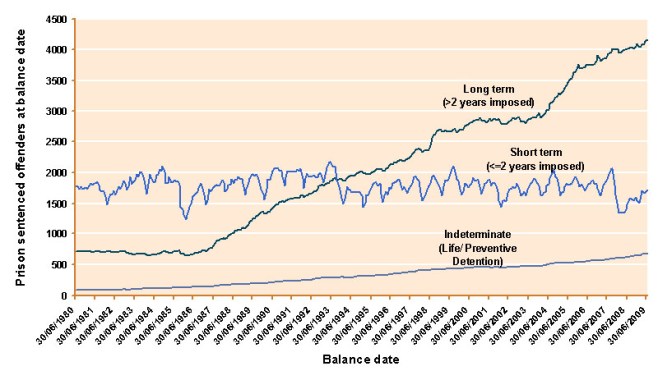
Graph showing the number of short term prisons has remained constant while the number of long term prisoners continues to rise – 1980 to 2009

A long-term sentence is anything over two years (from two years up to life).  Since 1985 ‘tough on crime’ legislation has significantly increased the number of long term prisoners (see chart above); the number of people given ‘long term’ sentences between two and three years went up 475%. In 2015, there were 765 inmates in this group, out of a total of nearly 5,000 long term prisoners.

These prisoners can only be released before the end of their sentence if the Parole Board decides they no longer pose an ‘undue risk’ to the community. Most attend their first parole hearing after completing one third of their sentence. But that doesn’t mean they get out. In the last few years, the Parole Board has become increasingly risk averse and now less than 5% of inmates are released at their first hearing – after which they serve the rest of their sentence in the community under the supervision of a probation officer.  Most long-term prisoners now serve approximately 75% of their sentence. The remainder serve their entire sentence.

So if the definition of ‘short-term’ was changed from two years to three years. That would allow an additional 765 inmates to be released automatically after serving half their sentence.  Prisoners serving four or five years could be automatically released after serving two thirds.  In 2015, there were 1,645 inmates serving between two and five years. Add this to the 1,500 no longer being held on remand and within five years, the population would be down about 3,000 – which is 30% within five years.

Prisoners also need accommodation and jobs when they get out. That requires long-term solutions, which would reduce the prison population by a further 20%. These solutions are addressed in How to cut the prison population by 50% – long term solutions

Open letter to Andrew Little & Jacinda Ardern

Jacinda
Jacinda Ardern promised “to bring kindness back”.

Jacinda Ardern, Prime Minister
Andrew Little, Minister of Justice
Parliament Buildings, Wellington

Dear Ms Ardern and Mr Little,

Your new government has taken some really positive steps in the justice arena after just a few short days in office.

Ms Ardern: On 26 October, 2017, in your first comments as Prime Minister, you said ‘I want the government … to bring kindness back’. In the Guardian newspaper read by millions  around the world, you were quoted as promising to form an “active” government that would be “focused, empathetic and strong”.

Mr Little: On your  first day on the job  as the new Minister of Justice you announced that Teina Pora’s $2.5m compensation for wrongful imprisonment would be increased to allow for inflation. That was the decent thing to do.

In the past you also voiced support for David Bain’s compensation claim. On 27 June 2013, you were quoted as saying that Ms Collins’ handling of the case had cost the taxpayer a “hundreds of thousands, if not millions of dollars, just because she’s made a mistake. And we’re all paying for it”.  You said she had acted too fast and without proper consideration of the facts, and that: “I think she’s going to be on the wrong side of this.” On 28 June you repeated your view that Justice Minister Judith Collins had “buggered it up”.

You also advocated for the establishment of an independent commission to review miscarriages of justice. On 27 October 2017, it was announced that such a body will be established under the coalition agreement between Labour and New Zealand First.  That’s good news – and long overdue.

But this is too late to help David Bain who, after 13 years in prison and another six years fighting for compensation, received $925,000 provided he agreed to cease all further legal action. The National Government stated that the payment was NOT compensation and Mr Bain would NOT receive an official apology. That was hardly a sympathetic response to Mr Bain’s drawn out legal battle for freedom and compensation.

Questions to Ms Ardern & Mr Little:

Given the compassionate response of the new government to Mr Teina Pora’s situation, will your government respond in a similarly empathic and active manner to Mr Bain. More specifically, is your new government willing to:

  • Advise Mr Bain that the payment he received is, in fact, compensation for the 13 years he spent in prison?
  • Increase the amount of compensation he received so it is in line with Cabinet guidelines of $100,000 per year spent in prison? This should take his payment from $925,000 to about $1.3 million.
  • Adjust the $1.3 million for inflation in line with the courageous Teina Pora decision?
  • Offer Mr Bain an official apology for the egregious mistakes made by the New Zealand police (as identified by Justice Ian Binnie and ignored by Justice Ian Callinan) which contributed to his imprisonment.

Yours faithfully

Roger Brooking
P.O. Box 29-075, Ngaio, Wellington

An unlikely conversation between Gareth Morgan and Garth McVicar

CartoonOne TOP party policy that hasn’t received much attention in the run up to the election is Gareth Morgan’s wish to reduce the prison population. He argues that rather than rehabilitating inmates, “prisons nurture crime”.

The Corrections Department’s own figures confirm the fundamental ineffectiveness of their rehabilitation programmes. This means that prisons don’t keep us safe either because these unrehabilitated prisoners are almost all released eventually. And prisons are incredibly expensive chewing up billions of hard earned taxpayer dollars that you could be used to fund more teachers, doctors, social workers and infrastructure.

Morgan: Garth we need to reduce the prison population by 50%. We need the money that Corrections spends on locking up prison inmates for other things like housing the homeless, treating drug addiction and improving mental health services in the community

McVicar: No, you’ve got it all wrong, Gareth. That’s what the prisons are for – to provide shelter for the homeless and take care of people with addictions and mental health problems. We need to put more of these losers in prison and get them off the streets.

Morgan: Yeah but that doesn’t solve the problem, does it? These guys don’t get any help in prison and eventually they get released on parole or at the end of their sentence. So, at the end of the day we’re no better off.

McVicar: That’s easily fixed Gareth. First, we need to abolish parole so these scum serve their whole sentence. We have to stop letting them out early. Second, we need to impose much longer sentences so hopefully these crims just die in prison. After all, life should mean life – not three years then out on parole after one year.

Morgan: But only 0.01% of prisoners have killed someone, you know, committed murder.  We can’t lock up robbers, shoplifters, drug addicts and drink drivers for life. Sentencing has to be proportionate – you know what I mean – the punishment should fit the crime. And they need help with their addictions.

McVicar: That left-wing claptrap is all well and good – but we have to lock these crims up for a long time to deter other people from drinking and stealing our stuff – otherwise everyone will be doing it.

Gareth
“Prison isn’t the solution to crime”

Morgan: But the academics say that this so-called theory of deterrence doesn’t really work – because most crims are mentally ill, brain damaged or addicted to alcohol or crack. They mostly commit crimes when they’re high as kites or drunk as skunks or to feed their addiction and the possibility of going to prison doesn’t even dawn on them.

McVicar: Don’t talk to me about academics. They’re the ones that got us into this mess by claiming that crime is the result of childhood abuse and dysfunctional parenting. It’s got nothing to do with parenting. My parents beat the crap out of me and look how I turned out. I don’t need an academic to tell me right from wrong. Crime is a personal choice made by people with no moral fibre.  Bugger this namby pamby approach, we need to use more corporal punishment on our children – that’s what turns them into real men.

Morgan: But it’s not just men Garth. There’s more and more women going to prison now as well. The vast majority of them have been sexually abused as children and because they’re psychologically damaged, they team up with abusive partners who beat the crap out of them.

McVicar: Well if you choose an abusive partner, you’re deliberately choosing to get beaten up. So, getting beaten up is a personal choice – just like crime. We have to take responsibility for our lives and stop blaming everyone else for our problems. The middle-class intellectuals have been coddling crims for way too long.

Morgan: But we can’t keep locking up more and more people Garth. Prisons are expensive. The prison population is at an all-time high. We’ve got 10,000 inmates. It costs $100,000 a year to lock up just one inmate and National wants to build another prison. When’s it going to stop?

McVicar: It’ll stop when the perverts are all locked up and the streets are safe to live in again…

Morgan: What do you mean? New Zealand is the second safest country in the world.

McVicar: That’s what I’m saying – locking up the bad guys is the only thing that works. Prisons create peace and harmony in society.

Morgan: (after a long pause with a look of bewilderment on his face) Yeah right!