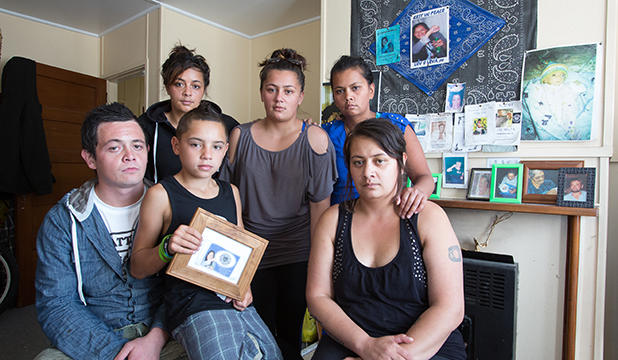
Prisoner dies when guards too busy to help – the case of Anna Kingi

Eva BradleyIn November 2011, the Waiikato Times reported that a Hamilton woman died in prison of a heart condition after her calls for help were ignored by guards. An inquest into the death of Anna Selina Kingi, 41, at the Auckland Coroner’s Court heard that Ms Kingi was found dead in her cell at Auckland Regional Woman’s Facility (in 2008) more than an hour after she activated her alarm.  She was mother of seven children (see photo) and grandmother of one and had been in prison for just under a month when she died.

The inquest heard that Ms Kingi was scheduled to see a doctor the day before she died, but the doctor was too busy and did not see her.  When she became distressed the next day (November 10, 2008), Ms Kingi pressed the emergency alarm in her cell  but prison guards ignored the call. One guard, whose name was suppressed, said she heard the alarm, but was busy so she just asked through the intercom if Ms Kingi was alright.  There was no answer. So she ignored it, did not send anyone to check, did not record the call and did not refer it to the incoming shift.

A few minutes earlier, another guard who was supposed to visually check her cell, failed to do so.  Three minutes before Ms Kingi pressed her cell alarm, she walked past Ms Kingi’s cell without looking in. She told police that rather than look in the cells, she fastened her digital ID to a broom handle, reached up and swiped the card over a sensor to make it look like she had done her rounds.

Cardiologist Dr Jim Stewart told the inquest Ms Kingi died of hypertrophic cardiomyopathy – an inherited disorder that causes thickening of the heart, making it hard for the heart to pump blood. He said normally there was a lead-in tachycardia (rapid beating) when the disorder led to a fall in blood pressure.  He said defibrillation or CPR could have worked if performed  in the first five minutes after the alarm. When Ms Kingi’s body was discovered more than an hour later, it took 13 minutes to get the keys and open her cell.  The inquest was told that at the time the prison had only one defibrillator and custodial staff could not have accessed it anyway.

This story is typical of the quality of healthcare offered to prisoners.  It is not dissimilar to the case of Justin Rys who also has a heart condition and has sleep apnoea. Mr Rys has to wear an oxygen mask while he sleeps – otherwise he stops breathing during the night placing additional stress on his heart.

While Mr Rys was in Rimutaka prison on remand earlier this year, the machine which pumps the oxygen broke down. For two weeks, nursing staff ignored his pleas for help. It was only when his lawyer intervened that Mr Rys was taken to hospital and given a new oxygen pump. If it hadn’t been for his lawyer, My Rys might also have died in prison.  Prison guards and nursing staff at Rimutaka clearly would not have cared.

Compensation

In April 2014, five years later, the Corrections Department “apologised unreservedly” and made a confidential payment to Ms Kingi’s seven children after the family initiated court proceedings. See: Apology, payout over prisoner’s death. Her children chose to sue Corrections’ chief executive Ray Smith after meetings between the parties failed to resolve matters,


Judicial insanity – man sent to prison 38 times – Steven Bunyan

A story in the Taranaki Daily News reports that 33 year old sickness beneficiary Steven Bunyan, has just been sent to prison for the 38th time. He was jailed for assaulting a family member (apparently his mother), contravening protection orders, breaching court release conditions and repeat drink-driving. He was jailed for 10 months and disqualified from driving for 12 months and one day.

Bunyan’s mother wrote in her victim impact statement that he reverted to his old ways when staying with her in Okato, that he was taking drugs and ‘always spaced out’. She said she had to think about the effect on the wider family. Judge Roberts noted Bunyan had nine previous convictions for assaulting women and his mother was one of three women who had protection orders against him. The judge said it was clear his problems were more than just alcohol-related and that he had anger issues.

Untreated mental health problem

No kidding!! It seems fairly obvious Bunyan has a mental health problem as well as a drinking problem. What possible benefit does the judge think this man – or society – will gain by sending him to prison again? He needs a psychiatric assessment and dual diagnosis treatment – in other words, integrated treatment for his mental health problems as well as his addictions.

There are at least three reasons Bunyan’s not getting this kind of treatment.

Short sentence syndrome

Let’s assume he first went to prison at the age of 20. If he’s been to prison 37 times before and he’s only 33, that means he’s been in prison an average of three times every year of his adult life.  In other words, Bunyan is a victim of the short sentence syndrome – he gets released halfway through each sentence (that’s the law for anyone given a sentence of less than two years) and never becomes eligible to attend rehabilitation in prison. (He’s probably never appeared before the Parole Board either – that requires a sentence of more than two years). When he gets out, he starts drinking and taking drugs immediately and before you know it, he’s breached a protection order or assaulted someone, and is back before the judge.

Judicial failure to assess

That leads to the second reason he’s not getting the treatment he requires. Judges have the capacity to order psychiatric assessments and alcohol and drug assessments prior to sentencing. They can even delay sentencing until an offender has completed a treatment programme. But they rarely do. AOD assessments are ordered for only 5% of offenders – even though 80% of all offending occurs under the influence of alcohol and drugs.

The ‘bad’ vs ‘sad’ approach

In Bunyan’s case the judge seems aware that he has a problem with alcohol – but doesn’t seem to be aware that Bunyan has a mental health problem. Why? Probably because Probation Officers are not trained to screen offenders for mental health problems. Probation reports are likely to describe Bunyan as a recidivist offender who repeatedly breaches court orders and for whom the only appropriate sentence is imprisonment.

Given that he’s been in the system for most of his adult life, it’s quite on the cards Bunyan attended rehab somewhere along the way. If he did, it obviously didn’t help. Probably the main factor leading to treatment failure is actually the failure of the treatment provider to assess and diagnose the patient’s co-existing mental health disorder.

Let’s say Mr Bunyan was seriously abused as a child, bullied at school and has undiagnosed post-traumatic stress disorder and lifelong feelings of depression. Let’s assume that at the age of 14 he started smoking cannabis and found this provided some relief from his symptoms – which included nightmares and hyper-arousal. At age 16 he started binge drinking and 17 years later (now aged 33), he’s dependent on both and has a short fuse – which leads to serious problems in his relationships with women.

Is rehab going to help? Not likely. Such a person needs a psychiatric assessment and a treatment plan which addresses both the underlying mental health problems and the addiction. Did any of this abuse or trauma happen to Mr Bunyan? I don’t know. But something sure did. The kind of problems he has don’t come from nowhere. Unfortunately, the justice system hasn’t taken the time to find out. It just chucks him back in prison as if more punishment will solve the problem. The sentencing  judge didn’t even bother to impose any release conditions on him.

The cost of failure

But let’s not forget that spending a year in prison costs the taxpayer $90,000. In 13 years, it appears Mr Bunyan has so far cost the taxpayer about $1 million. If this keeps up until he’s 50, it will cost nearly $3 million. What a complete and utter waste of money.  A private psychiatrist might charge $2,000 to do an assessment. Eight weeks treatment would cost about $6,000. Treating Mr Bunyan’s problems from a health perspective instead of a justice perspective might actually solve the problem – and save the taxpayer a fortune. No wonder Charles Chauvel wants to abolish short prison sentences.

Mr Findlay – 20 years in prison with no rehabilitation

Mr Findlay (not his real name) was referred for an alcohol and drug assessment by the Parole Board in March 2009. At the time of the assessment, he was 39 years old and had been in prison for a total of 20 years. He was serving a life sentence for stabbing a young man to death in a street fight just a few weeks after his 16th birthday. At the time of the assessment, he had been released on parole twice and recalled twice, and was seeking to be released on parole for the third time.

History of offending

Mr Findlay started drinking at the age of 13, and occasionally smoked cannabis. Prior to the murder, he already had eight convictions in the Youth Court – for shoplifting, burglary and theft from cars. He was already getting into in trouble and a week before his 16th birthday he was convicted of aggravated assault. Six weeks later he got into the fight in which the other young man died.

Once Mr Findlay was sent to prison, he smoked cannabis virtually every day. He spent ten years in prison before being released on parole. Once he got out, he carried on smoking cannabis but also started binge drinking. In the next five years, he incurred a further 12 convictions mostly for fairly minor offending (careless driving and fighting in a public place) before being recalled to prison again. He served another two years before being released a second time.

When Mr Findlay got out this time, he started using (and dealing) methamphetamine. He incurred another three convictions – for disorderly behaviour, dangerous driving and possession of methamphetamine – and was recalled to prison again. He is still in prison six years later.

Family background

Mr Findlay said his father was involved with the Mongrel Mob.  His mother did not want him raised in a gang environment, and gave him to his grandmother to look after.  He said his childhood was fairly normal up to the age of six – when his grandmother died.

After her death, Mr Findlay went to live with his mother for the first time. By this stage, she had a new partner and four more children.  He said his mother and stepfather both drank heavily and his stepfather abused and tortured him. He described an incident in which his stepfather forced him to hold a clothes peg between his teeth and then poured water down his throat – somewhat akin to water boarding.  He said his stepfather sometimes made him lie in the bath full of cold water for hours on end and forced his mother to make sure he stayed there.

Mr Findlay described another incident in which his stepfather threatened to kill him by shoving an electric jug cord down his throat while it was plugged into the wall. During this period of his life, he was beaten and bruised and often went to school with no breakfast.  He began stealing food off other children. Not surprisingly, his teachers became concerned about his welfare and took him to a doctor. He was diagnosed with malnutrition and a hernia and admitted to hospital.

Mr Findlay’s stepfather forced his mother to say she was responsible for Mr Findlay’s scars and bruises, and the police subsequently charged her with assault.  He was removed from his mother’s care and placed in a foster home.

Over the next few years, Mr Findlay lived in more than a dozen different foster homes and was sexually abused. He shifted from one school to another.  At the age of 13, he was sent back to his mother – who by this stage was no longer living with her abusive partner. However, Mr Findlay said that because his mother never protected him from the abuse, he hated living with her and ran away. He was sent to two different boys’ homes and at age 14, was placed in yet another foster situation. He says he was still in foster care when he was sent to prison at the age of 16.

Conclusion

As a result of being tortured and abused as a child, Mr Findlay appears to have developed post-traumatic stress disorder (PTSD). A month before the murder (after being charged with aggravated assault), he was interviewed by a probation officer and a psychiatrist. Neither of them made any mention of the abuse or the torture and the psychiatrist failed to make a diagnosis. An opportunity to intervene was lost and a month later, Mr Findlay killed someone.

Once in prison, three different psychological reports on Mr Findlay all described the way he was treated as ‘exposure to pathogenic care’ – meaning he was treated so badly, it was likely to lead to physical harm or ‘disease’. But once again, there was no mention of sexual abuse, no diagnosis and Mr Findlay never received any therapy.

Despite spending 20 years in prison, and seeing more than a dozen psychologists over this time, Mr Findlay was never diagnosed with PTSD and never required to attend drug treatment – either in prison or on the two occasions he was released on parole. However the three most recent psychological reports had all advised the Corrections Department and the Parole Board that he needed drug treatment.  The Department ignored the recommendations until 2009 – when the Board finally ordered an alcohol and drug assessment to be done.

Recommendation

I interviewed Mr Findlay and concluded that he appeared to have PTSD at the time of the murder and that his subsequent offending history had been driven by his mental health problems and his addictions – none of which had been treated despite spending 20 years in prison.

I recommended that Mr Findlay should attend the Drug Treatment Unit in prison. Mr Findlay has now completed that programme and said he gained a lot from it. He appears to have developed increased insight into himself and into the factors which led to his offending. He appeared before the Parole Board again in 2011, and once again, is working towards release. Eventually, he hopes to be sent to a supervised half-way house in the community.

Footnote on costs

 Before attending the Drug Treatment Unit, Mr Findlay had been in prison for nearly 20 years – at a cost of about $90,000 a year. In other words, nearly $2 million was spent keeping him in prison before he was required to attend a rehabilitation programme targeted at his primary offending issue (alcohol and drug dependence). During those 20 years, he was released twice with his addictions untreated and relapsed immediately.

Do you think the Sensible Sentencing Trust is sensible

In November 2011, the Sunday Star Times ran article about my new book called Flying Blind.  The story was about the need for a greater investment in rehabilitation programmes and said “Drug and alcohol counsellor Roger Brooking suggested setting up drug courts, increasing rehabilitation programmes, and investing in halfway houses.”

The story quoted Mr Brooking as saying: “About 90% of prisoners have drug or alcohol problems, but just 5% get the treatment they need. The justice system has become a vicious cycle and it recycles all these alcohol and drug-related offenders and keeps them locked into the justice system.”

Garth McVicar took exception to this. He issued a press release in which he says rehabilitation and therapy would be “a disastrous Corrections policy.” He went to say “The fact that two thirds of prisoners have drug and alcohol problems is not the fault of Corrections or prison.”

McVicar seems to be saying that if even if alcohol or drugs have contributed to criminal behaviour, the offender should not receive any help from the Corrections Department for this. Presumably Mr McVicar thinks that if mental health problems have contributed, offenders should not receive help for that either. If illiteracy and unemployment has been a factor, Corrections still should not help. If poor parenting and a lack of family support has been a factor, well, who cares?

Mr McVicar seems to have lost all capacity for reason – let alone humanity. He doesn’t seem to realise that 98% of prisoners will eventually be released – 80% of them within six months. Not only are 90% of them dependent on alcohol and drugs, a similar percentage also struggle with reading and writing. About 60% have mental health and personality problems. If they’re not offered help with these issues, they generally relapse to drinking and drugs as soon as they get out of prison; that leads to reoffending and then back to prison.

What Mr McVicar seems to have forgotten is that when criminals reoffend, they create more and more victims. If McVicar really cared about victims, he would join forces with Roger Brooking and advocate for more therapy and rehabilitation in prison and more support for prisoners in the community. The fact that he doesn’t highlights the flaws in his thinking, the short-sightedness of his strategy and the paucity of his compassion.

The reality is that Sensible Sentencing Trust policies do not support victims – they actually create more of them. Mr McVicar should rename his Trust – because there’s really nothing sensible about it.

How NZ encourages repeat drink driving

Obviously, not everyone who drinks and drives has a drinking problem. But many do. For someone who does have a drinking problem, poor decision-making is almost inevitable. The offender’s ability to think clearly is impaired by the continued abuse or dependence on alcohol. This impaired capacity was highlighted by a potentially amusing story reported in the NZ Herald in November, 2008. A woman in Hastings who had been drinking got into her car to drive home and on the way home, she got a flat tyre. In her inebriated state, she dropped in at the local police station to ask for help. Not surprisingly, the police smelt alcohol on her breath and she was subsequently charged with drink driving.

This case illustrates that for some drinkers, the cognitive capacity for sensible decision-making is largely non-existent. They’re drunk when they make the decision to drink and drive. However, when it comes to sentencing, judges should have no such excuse. But when it comes to addressing the underlying problem, many judges seem to make equally poor decisions. They repeatedly fail to order 95% of drink drivers to attend an assessment to find out if they have a drinking problem.

The shortage of treatment programmes 

In 2010, judges told the Law Commission they struggle to order offenders into treatment because of the shortage of treatment facilities in the community.  This argument has considerable merit. Numerous residential treatment programmes have closed in the last ten years and there are long waiting lists for those that still exist. But in some regions, courts don’t seem to be aware that funding is available from the Justice Department itself to pay for alcohol and drug assessments on these offenders. Judges in Wellington are an exception to this and utilise 80% of the $1 million put aside for these assessments.

This judicial reluctance to get offenders assessed is not confined to the rehabilitation of drink drivers. About 130,000 people are convicted in New Zealand each year for a huge variety of offences – 80% of it alcohol and drug related. However, judges order only about 5% of all offenders who appear in Court to have an AOD assessment.

Weak penalties for drink drivers in NZ

At the same time, New Zealand has some of the weakest penalties for drink driving in the western world. In Britain and Canada (and many states in the US), a 1st drink driving offence incurs a minimum disqualification period of one year. In New Zealand, the minimum is only six months for the 1st and 2nd conviction; a mandatory one year disqualification is only imposed for a 3rd offence. In Australia, a 2nd or subsequent offence incurs a minimum of three years disqualification. In Canada a 2nd offence leads to a two year disqualification. In Britain, drink drivers get three years for a 2nd offence.

Also, these other countries generally require drink drivers to attend counselling or treatment for their drinking problem before getting their drivers licence back. In New Zealand, 95% of drink drivers automatically get their driver’s licence back at the end of their period of disqualification – without even being assessed to see whether they have a drinking problem. One is inevitably led to the conclusion that the government and the  justice system have little interest in rehabilitation and little commitment to dealing with the underlying causes of offending. In fact, our system does so little to stop drink-drivers from drinking or driving that it ‘enables’ and encourages this kind of offending to continue.

Should short prison sentences be abolished?

The vast majority of those given a sentence of imprisonment serve less than 12 months. There are a number of reasons for this. First, there are so many low level crimes such as burglary, car theft, minor assaults, disorderly behaviour, possession of cannabis, etc, for which prison may be prescribed but which do not warrant a significant sentence. Most of this offending occurs under the influence of alcohol and drugs. Second, under New Zealand law, prisoners on short sentences – defined by the Corrections Department as two years or less – are automatically released after serving half their sentence.

What most people don’t know is that 80% of all prison sentences imposed by judges in New Zealand are for two years or less – meaning the vast majority of inmates serve less than 12 months. The problem is that very little rehabilitation is available; the Corrections Department has only recently introduced drug and alcohol treatment for those on short sentences. New Drug Treatment Units in three prisons enable about 500 short term prisoners a year to attend.

However,  there are more than 7,000 prisoners a year on short sentences – so not many will benefit. 90% of prisoners also have problems with literacy and very little assistance is available to address that either. The NZ Herald reports that Labour’s justice spokesman, Charles Chauvel, wants to eliminate jail sentences of less than six months because they are of “zero utility”.

Mr Chauvel said “abolishing short sentences, commonly used for minor offences such as drug possession and stealing cars, would free up money to help offenders with their education and addictions”.

Labour also proposes more use of police diversion for people caught possessing drugs or committing minor offences under the influence of drugs or alcohol. This is the first time one of the two main parties has embraced the idea of treating the impact of substance use on offending primarily as a health issue rather than a crime.

Do prisons deter crime?

The current Minister of Corrections, Judith Collins believes prisons deter criminal offending. In a speech at the Auckland Region Women’s Corrections Facility in October 2009, she said: “Certainly, the belief that they will be caught and punished is the greatest deterrent for criminals”.

Two years later, she continues to hold on to this erroneous perspective. When Ms Collins opened the new prison in Mt Eden in March 2011, she dismissed concerns about the new prison being so visible from the street, claiming that it acted as a deterrent to potential offenders.

Canadian research on deterrence
Ms Collins is remarkably uninformed. There is no research indicating that imprisonment deters criminal behaviour. On the contrary – the available research all points in the other direction. A Canadian study from 2001 says:

“A recent research paper from the office of the Solicitor General of Canada brings together the results of 50 studies of the deterrent effect of imprisonment involving over 300,000 offenders… Longer sentences were not associated with reduced recidivism. In fact the opposite was found. Longer sentences were associated with a 3% increase in recidivism. This finding suggests some support for the theory that prison may serve as a ‘school for crime’ for some offenders… No evidence for a crime deterrent function was found”.

New Zealand research
New Zealand’s recidivism statistics confirm the ineffectiveness of prison as a deterrent. Approximately 43% of all prisoners and 65% of those under 20, re-offend within a year of their release. Within five years, over half will return to prison – often more than once. For those under the age of 20, more than 70% are back inside within five years. In 2009, Arul Nadesu, principal strategic adviser for the Corrections Department, wrote:

“Analysis confirms simply that, the more time in the past someone has been in prison, the more likely they are to return to prison following any given release.” 

After three years on the job, it seems that Ms Collins has not read any research on the role of prisons in society – unlike Finance Minister, Bill English, who at least put some thought into this, and declared prisons to be a ‘fiscal and moral failure’. But even Mr English wasn’t prepared to put his money where his mouth is. The same day that he made this announcement, Corrections Department officials were in the process of making a submission to the EPA to build another 1,000 bed prison in Wiri.

Hypocrisy and incompetence
Mr English’s stance is hypocritical – he says prisons are a fiscal failure but is willing to spend an estimated $424 million building another one.  But Ms Collins’ superficial knowledge of the subject is bewildering – and surely borders on incompetence. Given her inability to acquire even a rudimentary understanding of the role of prisons, why John Key would keep her on as Minister is hard to fathom. Or is it? He and his colleagues are all part of the ‘lock ’em up brigade’ and the continuing campaign of misinformation perpetrated by the Minister.

Radical suggestion for the proceeds of crime

Earlier this year, Police Minister Judith Collins announced that the police have seized $48 million off criminalsfrom the proceeds of crime. The Criminal Proceeds (Recovery) Act, which took effect in December 2009, enables Police to seize assets without even securing a criminal conviction.

There’s a fundamental injustice in taking property off people who haven’t been convicted of a crime linked to the acquisition of that property. That’s theft – and the scale on which this occurs ($48 million) makes the police the biggest criminal gang in the country. This is not the only piece of legislation passed by National which empowers the police to breach basic human rights. National has even indicated its intention to pass retroactive legislation authorising illegal video surveillance being conducted by police. Constitutional lawyer Mai Chen has a number of concerns about this legislation and says:

“The Government’s proposed change to the law will retrospectively validate illegal conduct by the police.”

Ignoring the wholesale erosion of the Bill of Rights taking place under this Government, there’s another issue – what it then does with these so-called proceeds of crime. A spokesman for Justice Minister Simon Power said a fund for fighting illegal drugs was being set up in consultation with the Justice Ministry and the Treasury. Really? There’s already a fund for that – it’s what the police are paid to do and their budget is currently over $1 billion a year. Do the police need extra funding? Not really. The money would be better spent addressing the causes of crime.

Funding of substance abuse
One of the common causes is substance abuse. In fact, 80% of crime occurs under the influence of alcohol and drugs. But currently only 25,000 New Zealanders a year are able to access treatment. This is because not enough funding is put into treatment – currently only about $100 million a year. In 2009, NCAT (the National Committee for Addiction Treatment) said funding for addiction needed to be increased by 150% just to provide sufficient capacity to treat 50,000 people.

The problem is NCAT claims that at least 160,000 New Zealanders need substance abuse treatment – and even this is a conservative estimate. In its review of the Misuse of Drugs Act, the Law Commission quoted a 2006 study which suggests 5.8% of the population have significant problems with alcohol and drugs and would benefit from treatment. 5.8% is nearly 255,000 people.

It gets worse. In 2010, the BERL report on harmful alcohol and drug use said 667,000 Kiwis engage in harmful levels of alcohol and drug use each year. About 120,000 of them end up in court – 30,000 for drink driving alone. When 80% of crime occurs under the influence of alcohol and drugs, the treatment sector is clearly in greater need of extra funding than the police.

Turn seized properties into half-way houses
Among the proceeds seized by police were 42 residential properties and 10 lifestyle blocks. If the Government intends to hang onto them, these could be gifted to agencies supporting prisoners like PARS (Prisoners Aid and Rehabilitation Societies) and NZPF (New Zealand Prison Fellowship) – and turned into half-way houses for ex-prisoners.

9,000 people are released from prison each year – but the Corrections Department currently funds only two half way houses in the entire country; there are none in the North Island and none for women anywhere in the country. The result is that only 1% of prisoners in New Zealand are released into supervised accommodation.

Compare that with Canada where there are over 200 half-way houses and 60% of those coming out of prison go there. It should be no surprise that the Chairman of the Parole Board, Judge David Carruthers believes Canada is five to six times more effective than New Zealand at reducing re-offending.

$48 million is a lot of money. If Government is going to hang onto these ill-gotten gains it should be used to rehabilitate and reintegrate the crims who commit the crimes – rather than wasting it on the police.

14,000 prisoners on remand excluded from rehabilitation

More than 20,000 people spend time in New Zealand prisons every year and most are excluded from rehabilitation programmes. Being illiterate is one of the excluding criteria. Those on short sentences are also excluded. However, the largest cohort of prisoners prevented from attending are those on remand awaiting trial or sentencing. 14,000 New Zealanders end up in this situation every year – some for just a few weeks, others for years.

British research on remand prisoners:  There are very good reasons to start rehabilitation while offenders are on remand. British research has found that remand prisoners tend to experience very high levels of social deprivation. They are five times more likely than sentenced prisoners to have lived in a hostel prior to imprisonment and are less likely to have had a job. They also have higher levels of drug dependency.

In 2005, Britain’s Home Affairs Committee produced a report on rehabilitation issues and recommended that:

“Remand prisoners should undergo a needs assessment on reception to prison, including mandatory drug testing, and the Prison Service should develop a separate prison regime tailored to meet their specific needs. This regime should include a short induction programme, education and work opportunities and drug and alcohol treatment programmes, with arrangements in place for continuation of treatment and programmes in the community…

“Time in prison can offer a window of opportunity to start to change. These measures are especially relevant to remand and short-term prisoners, because they are more likely to be in prison for drug-motivated crimes, and treatment is more urgent because they will be released sooner”.

New Zealand research: There is little research in New Zealand on the level of drug abuse and social exclusion experienced by prisoners on remand. But the thrust of the argument made by the British Home Affairs Committee applies equally well in New Zealand. Since 80% of crime is committed under the influence of alcohol or drugs, the average remand prisoner is highly likely to have problems with substance abuse. They often have unstable accommodation and are sometimes remanded in prison simply because they have nowhere to live.

We even build prisons especially for them. Earlier this year, the Corrections Department spent $218 million on a brand new prison in Mt Eden with nearly 1,000 beds – just to accommodate remand prisoners in Auckland. Although it houses up to 1,000 prisoners at a time, many more will spend time there in the course of a year. Not one of them will be allowed to attend a rehabilitation programme.

Why the justice system is so ineffective

In my new book,  Flying Blind – How the justice system perpetuates crime and the Corrections Department fails to correct, I identify three stages in the system where intervention could occur – but generally doesn’t.

1) In Court: The first is when offenders appear in Court. Research indicates that over 80% of all offending occurs under the influence of alcohol and drugs – but judges order alcohol and drug assessments on only 5% to 10% of all those who appear in  Court. Even with drink drivers, where the link with alcohol is obvious, the courts still order only a small percentage to be assessed, and even less to attend treatment.

2) In prison: The second stage is when offenders are sent to prison. The National government is in the process of doubling the availability of addiction treatment in prison so that 1,000 inmates a year can attend. But over 20,000 New Zealanders spend time incarcerated each year – most on short sentences. Doubling the availability of substance abuse treatment still allows only 5% of those in prison to attend. Flying Blind identifies numerous other obstacles that stand in the way of prisoners attending rehabilitation programmes.

3) On release from prison: The third stage is when prisoners are released. Many, if not most, prisoners come from dysfunctional families and have been subject of multiple trauma and adversity as they grew up. On release, they often require accommodation, a job and pro-social support if they are to avoid relapsing to alcohol and drugs and avoid re-offending.  The Corrections Department does not prioritize the reintegration of prison inmates and provides supported accommodation for less than 1% of prisoners on release – compared with 60% in Canada where re-offending rates are much lower. Flying Blind identifies this as one of the main factors contributing to New Zealand’s high rate of recidivism.

It makes the case that the lack of rehabilitation and support provided to criminals creates a vicious cycle from which it is almost impossible for a drug or alcohol addicted offender to escape – which is why the justice system is so ineffective. The final chapter of the book concludes:

“This is not a system which delivers justice. It delivers retribution and temporary containment – but very little else. It doesn’t rehabilitate and it certainly doesn’t reintegrate. It doesn’t deliver deterrence, no matter what uninformed politicians may think, and it certainly doesn’t keep the community safe. “

Only 5% of prisoners receive drug treatment

To put it politely, Corrections Minister Judith Collins is an accomplished spinner:

1) Incorrect figures:

She claims that two thirds of prisoners have problems with alcohol and drugs. But Ms Collins is misinformed. The figure of two thirds is the percentage of prisoners that, in 2008, had substance abuse treatment listed as part of their sentence plan – hardly a reliable source of information.

The reality is that sentence planners are not trained at assessing alcohol and drug dependence and the problem is much worse than the Minister claims.  The most recent independent research on the prevalence of alcohol and drug use problems among prisoners in New Zealand puts the figure between 84% and 89%.

2) The real figures:

Collins regularly claims that Government has doubled the availability of drug treatment in prison – from 500 to 1,000 places a year. It sounds impressive. But each year over 20,000 people spend time in prison – the vast majority with alcohol and drug problems. If 1,000 prisoners a year attend treatment, that’s less than 5% of the total. Doubling the availability of drug treatment in prison is not what it seems.

3) What it costs:

Ms Collins claims that doubling the number of prisoners in treatment targets one of the key drivers of crime – and that in 2009/10 Corrections spent $137.5 million on rehabilitation and reintegration. What she doesn’t say is that only $4.7 million is spent on drug treatment in prison.

Compare that with the $6 million being spent on new uniforms for prison officers (starting in September); or $11 million spent on cell phone blocking technology which doesn’t work; or $12 million to cover VIP transport arrangements for the World Rugby Cup, including use of 34 brand new BMWs recently purchased by government for the discounted price of $4.7 million – the same amount spent on drug treatment..

Conclusion

When there are over 20,000 offenders circulating through New Zealand prisons each year; when crime costs the country $11 billion a year – and most of it is alcohol and drug related; when recidivism is at an all time high – the $4.7 million spent on drug treatment in prison is pathetic. When the Government spends more on new uniforms and BMWs than on drug treatment, any claims by Judith Collins that reducing re-offending is a Government priority are part of Corrections’ campaign of misinformation.

To separate the spin from the facts, read Roger Brooking’s: Flying Blind – How the justice system perpetuates crime and the Corrections Department fails to correct.

The $6 million men at Corrections

Corrections Minister Judith Collins has just announced that 4000 Corrections officers will wear new blue uniforms to replace the green ones that officers have been wearing since the 1970’s. The cost of each of the new uniforms is about $1,500. Do the maths – that’s $6 million – which Ms Collins says will be met from the Department’s existing budget.

What the money could be spent on

What that means is that there is $6 million less in Corrections’ budget for rehabilitation or reintegration. That’s a problem – because 90% of prisoners have alcohol and drug problems, but only 5% of the 20,000 in prison each year are able to attend addiction treatment. This is because Corrections spends only $3.4 million a year on it.

90% of prisoners also have problems with reading and writing and Ms Collins claims to be doing something about this too. In 2010, 1,496 prisoners attended classroom based literacy and numeracy education – but only 9% were assessed by their tutors as having reached a satisfactory level and actually completed the programme. Nine per cent of 1,496 is only 135 prisoners…!

Another systemic failing is the lack of supported accommodation Corrections provides for inmates when they get out of prison. In Canada, over 60% of federal prisoners are released into half way houses – and this makes a significant contribution to Canada’s low rate of recidivism. In New Zealand there are only two such houses – and less than 1% of ex-prisoners get into them. No wonder so many relapse to alcohol and drugs and then re-offend.

What’s the real priority?

Despite these poor results, Judith Collins frequently claims that: “Rehabilitation and reintegration are a key Government priority in its drive to reduce re-offending.” (See the Department’s Annual Reports).

Yeah right! The reality is that governments have never put much funding into assisting prisoners with reintegration. But demonstrating its true colours, National recently allocated $12 million to host foreign diplomats and cover VIP transport arrangements for the World Rugby Cup. This includes use of the 34 brand new BMW’s recently purchased by the Government for the discounted price of $4.7 million. Why? Because the real priority is PR and appearances – and the $6 million uniforms will no doubt look good. They may even be more comfortable, but they will not hide Corrections’ continuing failure to address New Zealand’s problems with recidivism.

When crime costs the country $11 billion a year – and most of it is alcohol and drug related; when there are 20,000 offenders circulating through New Zealand prisons each year; when recidivism is at an all time high – and Government spends more on new uniforms and on VIPs and BMWs than it does on drug treatment and critical support services – any claims that rehabilitation and reintegration are priorities are a joke. This is all part of Corrections’ continuing campaign of misinformation.

The Emperor’s new clothes

Real priorities require commitment and funding – at the moment, neither is available to rehabilitate criminal offenders. The current priority is all about looking good – for prison officers, and for Judith Collins. It all reminds me of the fairy tale about the emperor’s new clothes – that’s another saga of self-delusion.

$11 million wasted on cell phone blockers that don’t work

The first cell phone blocking technology in New Zealand prisons was installed in 2007 – primarily to prevent drug dealing. In April 2010, prisoners at Rimutaka told alcohol and drug counsellor Roger Brooking they were still able to make cell phone calls. A Dominion Post journalist spent a night in Rimutaka Prison and reported that he had no problems using his cell phone – even from inside the prison.

Budget blowout to $11 million

A year later, another inmate told Mr Brooking that cell phones on all three networks were still being used in every unit in the prison. The Dominion Post ran a second story concluding that the technology is flawed and provides only partial coverage. It also said the system was budgeted to cost $6 million but repairs and upgrades have blown the budget to nearly $11 million. Apparently, it will cost another $2 million just ‘to fully jam Rimutaka’ prison alone. That’s $11 millions spent trying to stop drugs coming into prison, while the Department spends only $3.4 million on drug treatment in prison each year.

Dubious contracts require review

On top of this spectacular waste of the taxpayer’s money, the Dominion Post also queried the way in which the Department allocates contracts worth tens of millions of dollars to private sector consultants and contractors. Corrections apparently failed to advise Parliament’s law and order select committee that a multimillion-dollar contract had been awarded to Honeywell, an international security firm given the task of setting up the phone blocking technology.

The Dominion Post reported that at least two former Honeywell employees now work for Corrections and actually manage Corrections’ contract and approve payments to Honeywell. The Dominion Post was so concerned about the Department’s dubious contracting procedures, it ran an editorial calling for an inquiry. Judith Collins is the Minister responsible and no inquiry has taken place.

The legacy of former Chief Executive Barry Mathews

Perhaps the saddest part of this saga is that although the technology is ineffective and cost twice as much as budgeted, former chief executive Barry Mathews listed its implementation as one of his three greatest achievements. His other top achievements were better sentence compliance by the Probation Service and the establishment of the Professional Standards Unit – which investigates corruption by prison officers.

In other words, despite five years as chief executive, Mr Matthews was unable to list as an achievement anything to do with rehabilitation, reintegration or reducing re-offending – despite Ms Collins claiming that these are government priorities.

7,000 prisoners on short sentences excluded from rehabilitation

Over 7,000 people in New Zealand are sent to prison each year on ‘short sentences’ – defined by the Corrections Department as two years or less.  In fact, 80% of all those sent to prison are given short sentences – and are automatically released after serving half of their time.  Only offenders imprisoned for two years or more serve their whole sentence – unless the Parole Board releases them earlier. Ever since the Graeme Burton debacle, most of those on ‘long’ sentences now serve at least two thirds.

Because short-term prisoners not there for very long, the Corrections Department does not generally allow them to attend education, training or rehabilitation programmes. The Department’s website says: “The amount of time to be served (by those on short term sentences) is likely to severely limit the offender’s opportunities… This means it is very unlikely that these offenders will attend rehabilitative programmes while in prison.”  

The revolving prison door

Many offenders given short sentences commit ‘public nuisance’ type offending – usually under the influence of alcohol. Often they are in and out of prison again and again without attending any kind of intervention. To get into a rehabilitation programme in prison, they have to commit a more serious offence and receive a sentence of more than two years – otherwise they’re not likely to be eligible.

In other words, out of the thousands of New Zealanders sent to prison in the last 50 years, 80% have not been allowed to attend any rehabilitation programmes – because their offending was not considered serious enough. So they sit around for up to a year with virtually nothing to do – as described in the Ombudsman’s report on the treatment of prisoners in 2006.

A drop in the bucket

It may be that this short-sighted approach is beginning to change. In June 2010, a three-month alcohol and drug programme began at Otago prison targeted at short-term offenders. This will allow around 120 short-term inmates to receive treatment. In November 2010, another drug treatment unit (DTU) opened at an Auckland prison. A third DTU opened at the Wanganui prison in Septemeber 2011, enabling the number of short-term inmates eligible to receive alcohol and drug treatment to about 500 per year. That’s 500 places for 7,000 prisoners sent to prison each year on short sentences – little more than a drop in the proverbial bucket. Since the vast majority of those in prison have alcohol and drug problems, they will still miss out.

Want to know more about our crazy prison system? Get the inside story from: Flying Blind – How the justice system perpetuates crime and the Corrections Department fails to correct. 

Let’s rob another bank – the case of Craig Andrew Blair

In September, the Dominion Post reported the sad case of Mr Craig Andrew Blair who robbed a bank in Rotorua – not for financial gain but so that he would be sent back to prison. He went into the bank, approached the teller with a note demanding money and said he had a gun in his bag. After being handed $1,140, Blair walked 400 metres to the Rotorua Police Station to give himself up. No weapon was found.

At sentencing, his lawyer told the Court that Mr Blair couldn’t cope living on the outside. He had no support and spent the money he was given on leaving prison (usually $350) on alcohol. The probation report said Blair had psychological problems and suffered from depression. Not surprisingly, the report also said he was unmotivated – generally one of the main symptoms of depression. The judge sentenced him to two years and nine months jail.

This robbery was almost identical to another committed by Blair three years earlier. In 2008, he also robbed a bank in Te Puke in order to get himself returned to jail. According to the summary of facts in that case, Blair entered the bank carrying a backpack. He took a deposit slip and wrote on the back of it: “I’ve got a gun in the bag. Give me the $ or I’ll kill you.” The teller handed over $650. Putting the money in his backpack, Blair left the bank, walked about 20 metres away and sat down on a park bench until the police arrived to arrest him.

On that occasion, the judge also ignored probation and psychological reports indicating he needed help and sentenced him to 2½ years in prison. It’s now 2011 – deja vu.

The lack of rehab in prison

Mr Blair clearly has significant psychological problems. He suffers from depression and has a drinking problem. He knows how to cope in prison but lacks the skills and the support to cope on the outside. It’s a sad and pathetic case. But the real tragedy is the extraordinary lack of rehabilitative support offered by the Corrections Department to assist offenders with mental health and substance abuse disorders – either in prison or on release.

It’s not known if Mr Blair attended substance abuse treatment in prison – but probably not. Less than 5% of the 20,000 people who end up in prison each year are able to attend. Even if he had attended, this would not have helped if his underlying depression and lack of coping skills were not addressed at the same time. ‘Best practice’ requires patients with co-existing mental health and substance abuse disorders to receive integrated treatment for both disorders.

The lack of support on release

Blair has now been released into the community twice without support, adding to his fragile state of mind. New Zealand has only two halfway houses funded by the Corrections Department and less than 1% of inmates are released into them (compared with 60% in Canada). At the very least, he should have been released into a residential treatment programme – not left to roam the streets and drink himself into a stupor.

This case is an indictment of the judicial system as well as of Corrections. Two different judges ignored psychological reports and sent this sad and depressed individual into a prison system which is incapable of assisting people with complex psychological problems. By the time he finishes his current stint, he will have been in prison for at least five years – at $90,000 a year. This will end up costing the taxpayer at least $450,000.  Compare that with Prozac – which costs about five cents a day. Or two months in rehab – which costs about $6,000. Society is no safer because Craig Blair is in prison. When he offends, he doesn’t hurt anyone. And when he gets out, he’ll just do it again.

Time for an inquiry

Keeping people in prison, failing to treat the causes of the offending and releasing them without support, destroys lives and is a waste of financial resources. When the Government is facing the biggest deficit in its history, its time New Zealand re-assessed this deceitful strategy. In 2008 Simon Power called for an inquiry into the availability of rehabilitation in the justice system. Then he became the Minister of Justice and didn’t want one. Still more deceit. Labour MP Rick Barker has also called for in inquiry into recidivism calling it an ‘intractable problem’. It’s high time an inquiry took place.