Health & Disability Commission endorses inhumane treatment of prisoners

cellNo one would be surprised to hear that standover tactics, bullying and violence are rife in prison. But you may be surprised to learn that prison nurses in New Zealand also engage in this kind of behaviour.  In 2006, management at Corrections were so concerned about bullying by prison nurses, they asked the Health & Disability Commission to investigate.

The HDC dispatched two employees, Dr Elizabeth Finn and Mr David Webber to conduct a series of workshops in prison health centres. The first was held at the Waikeria prison in 2006 and workshops were subsequently held in another 12 prisons.

In 2008, a damning summary of the HDC’s findings was released in a report titled Team development workshops for prisons nursing services delivered by Dr Elizabeth Finn and Mr David Webber“. In September 2009, a copy of the report was sent to the Ombudsman by HDC chief legal advisor, Nicola Sladden, describing a “culture of horizontal violence and bullying” within prison health centres. It identified the following problems:

Lack of leadership

  • “Not all nursing teams had a team leader, and not all of those that had a team leader experienced team leadership… Many teams identified a lack of cohesion in coordination with the team; this appears to occur in the presence of a team leader as well is in its absence.” 
  • “Workshop discussions often identified situations where inadequacies in team operation actually or potentially compromise the care of patients and/or safety of members of the nursing team… ”  
  • “There is great variation throughout the country (in team morale/culture). In some teams it was excellent and the team obviously was open, respectful and vibrant. In other teams this was identified as being very poor, to the extent that some nurses felt disinclined to come to work. Team culture was characterised by negative attitudes and interactions among nurses, (including) in-fighting, unkindness, backstabbing, and actions intended to discredit colleagues.”  
  • “Some nurses experience treatment from custodial officers which shows no respect for them personally or for their role in delivering healthcare. Some nurses speak of having to ‘serve an apprenticeship’ of up to two years before custodial officers will accept them – speak to or respond to them. Some officers may interfere in discussions between a nurse and a patient, possibly ‘winding up’ the patient and making delivery of care more difficult.”

Discouraged medication policy

Another failing identified by Finn and Webber concerned the prescribing of medication by prison doctors. The authors wrote:

“It appears that some doctors are not sufficiently aware of the context of the prison environment and the particular challenges it presents. For example, some medications are inappropriate in this environment because of their potential for use as ‘currency’. Lack of national consistency with respect to provision of medications to patients who are prisoners may lead to stand-over tactics and abuse directed towards doctors in the first instance, and also towards nurses. A robust induction programme for doctors would be helpful.”

From time to time, prisoners have to be taken to hospital with serious injuries or medical problems. Finn and Webber even reprimand doctors in hospital Emergency Departments – apparently for not doing what they are told by prison nurses. The report says:

“(Doctors in) EDs may not be co-operating with advice from nurses that certain medications are not allowable in prisons, and are still prescribing these (codeine, morphine).”

In cases of severe pain, opiates such as codeine and morphine are likely to be the medications of choice. But the HDC seems to believe that, even in medical emergencies, prisoners should not have their pain relieved. Apparently they should continue to suffer – even when the pain is so bad they need to be taken to hospital.

Unfortunately, this ‘discouraged medication policy’ extends well beyond opiate pain relief. All medications including antidepressants and antipsychotic drugs are taken away from prisoners – usually on their first day in prison.  Although this practice varies from one prison to another, often such medications are never reinstated.

Breach of  human rights and medical ethicsPrison doc
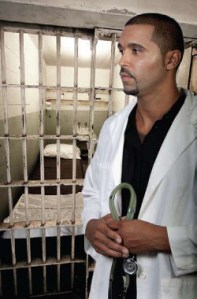
Denying patients clinically appropriate medication, especially when they are in severe pain or have mental health disorders, is inhumane and a breach of human rights. It contributes to depression and even to suicide. The reality is that the systematic denial of opiates and other clinically appropriate medication is a form of pharmacological or ‘clean’ torture; it causes serious harm and distress to the prisoner without leaving any visible evidence.

The policy also encourages prison doctors to breach their medical ethics. The New Zealand Code requires physicians to “Consider the health and well-being of the patient to be your first priority” and to “render medical service to that person without discrimination.”  When doctors are coerced into making prison policy their first priority, and discriminate against the patient because he or she is in prison, they risk being struck off for breaching their ethics.

What’s extraordinary is that the Health and Disability Commission seems to condone this practice. For a Government agency with responsibility for promoting safe medical practices, this is truly disturbing. It suggests the HDC is complicit in Corrections strategy to breach the human rights of prisoners and raises serious questions about the integrity of investigations into complaints by prisoners who need these medications.

The Commissioner’s response

In July this year, I wrote to the HDC and asked if they still endorse this ‘discouraged medication policy’. Mr Anthony Hill, the Commissioner, replied:

“It is not HDC’s practice to endorse the policies or procedures of health care providers. This is because I must consider complaints to HDC fairly, with an open mind and free from bias. This may be called into question if I have previously endorsed a policy or procedure that is the subject of a complaint to HDC.”

That’s the whole point. The Finn Webber report is quite clearly an endorsement of Corrections discouraged medication policy and my letter therefore questions the integrity of all HDC investigations into prisoner healthcare in the last five years. Since Mr Hill refused to acknowledge the bias in the HDC’s position, I have now written to the Ombudsman suggesting that if the HDC does not endorse this particular policy, then the Ombudsman should encourage the Commissioner to write to Corrections and tell them so. Otherwise, the Finn Webber report gives the Department every reason to continue medication off prisoners – thereby leaving them in pain and distress – and believing the HDC endorses this unethical practice.

I also suggested to the Ombudsman that he/she should persuade the Corrections Department to change this practice and remove it from their Medicines Policy. This is because New Zealand is party to the Convention against Torture and Cruel, Inhuman or Degrading Treatment or Punishment  which requires Governments to take effective measures to prevent the torture and ill treatment of people who are detained by the State.  And since 2007, when New Zealand signed the Optional Protocol to the Convention against Torture (OPCAT), the Ombudsman became one of the monitoring bodies with responsibility to ensure that New Zealand meets its obligations under the Convention. If he does not intervene, then by failing to act, the Ombudsman is also condoning and endorsing the torture and ill treatment of New Zealand prisoners.


Serco leaves prisoners to fight among themselves

Bevan HanlonIn early October, Bevan Hanlon, president of the Corrections Association (left), said 12 out of 20 new recruits employed at Mt Eden prison in the past two months had left their jobs because of security fears. Then last week, he  said staff at the prison sometimes leave up to 45 prisoners in a unit on their own with no supervision and as a result “ prisoners are assaulting each other and beating each other up.”  Hanlon says many fights go unreported because “no guards are there to see them happen… prisoners are being left to fight among themselves”.  

This reinforces comments made a year ago by former prison inmate, Martin Lyttleton (below), who said violence was rife in prison, especially in the Auckland Central Remand Prison (now MECF) where gang members seemed to be in charge.  Martin Lyttleton

“They were running fight clubs in the mainstream units, so a lot of people were getting bashed up… In some cases the guards were actually sanctioning assaults by inmates on other inmates”, he said. “There were few programmes or rehabilitation courses, and so the inmates were bored and looked for trouble”

“The guards were actually sanctioning assaults by inmates on other inmates.  They were conscious that an assault was going to take place. [They would] leave the unit, the assault would occur, then they would come back into the unit afterwards and it was discussed amongst the inmates that it was a guard-sanction assault.”

Serco

Mt EdenThe Mt Eden Correctional Facility (left) is operated by Serco, the British consortium with a history of dodgy management practices.  In July this year, the Guardian newspaper reported that the Serco-run Thameside facility has been rated as one of the three worst prisons in Britain. A month later the Guardian reported that police had been called in to investigate fraud allegations against Serco for overcharging the Government by as much as £50million to operate a contract to transport prisoners to and from courts across London and East Anglia. In September, Guardian Australia revealed that key performance reports from Serco and G4S, the companies that run detention centres on Australia’s mainland, and the regional processing centre on Manus Island, do not exist. The missing reports are supposed to monitor the welfare, care, security, health and medical, counselling and education of detainees.

In New Zealand, the Government’s contract with Serco still leaves the Corrections Department with ultimate responsibility to ensure that custodial sentences are “administered in a safe, secure, humane and effective manner”.  The Department is  required by the Corrections Act to ensure that all prison facilities are “operated in accordance with rules set out in the Act… and are based on the United Nations Standard Minimum Rules for the Treatment of Prisoners.”

Assaults

It’s not just Mt Eden prison which has problems with violence.  The reality is that Corrections struggles to provide a safe environment in any of its prisons. In the last five years the number of prisoners attacking other inmates in New Zealand has nearly doubled.  In 2011, 862 inmates were assaulted by other prisoners, 48 of which were classified as ‘serious assaults’.   Jason Palmer In 2006/07, there were only 27 ‘serious’ incidents.  In 2010/11 there were also 241 assaults on prison staff and in May 2010, Jason Palmer (right) became the first prison officer to be killed in a New Zealand prison after he was punched by inmate Latu Kepu.

In a media interview in April 2012, Corrections general manager of prison services, Jeanette Burns, claimed the number of serious assaults on prison staff had dropped dramatically since 1995 and said fewer prisoners were requesting voluntary segregation to avoid violence and gang related problems in mainstream prison units.  That’s managerial spin. The reality is that Corrections revised its policy on voluntary segregation in 2011 and implemented a new screening process which allows staff to decline prisoners’ requests to be placed on segregation.

Ms Burn’s assertions were also challenged in October 2012 by new figures showing serious assaults on prison guards have, in fact, tripled in the past five years. During the year to the end of June, 18 staff were seriously assaulted – up from just six in 2007. Springhill fireEven the Auditor General said the number of serious assaults is “well above the expected level”.  Prisoner-on-prisoner assaults were 85% higher than expected and prisoner-on-staff assaults were 160% higher than expected. Much of the violence is gang related including the eight hour riot at Spring Hill prison in June this year in which buildings were set on fire (left) and three guards were left with broken bones. Repairs were expected to take six months and to cost millions of dollars.

Corrections perceptions

It should come as no surprise that violent assaults in prison have impacted on officers’ perceptions of their personal safety. In 2011, only 69% of staff reported feeling safe working in prison.  Nearly half believed they could not report unethical behaviour by other officers without fear of reprisal, or believed that Corrections would not hold officers accountable for such behaviour.  Radio New Zealand’s revelations suggest that staff at the Serco-run prison feel even more vulnerable than officers in Corrections’ prisons.

But the Department always puts a positive spin on things.  In May Corrections reported that Serco was outperforming most of the state prisons in comparative tables which measure one prison against another. The tables include the number of assaults occurring in each prison – the number being reported to be more precise – and Serco’s performance was rated as “exceptional”. What does that say about all the other prisons? The reality is that there is nothing exceptional about anything in the New Zealand prison system. Only Scandinavian countries can make such claims.

Management at Corrections are exceptionally good at just one thing – they have an extraordinary ability to spin the facts and turn a blind eye to the truth; and the truth, according to Deputy Prime Minister Bill English, is that our prisons are ‘a moral and fiscal failure’.

The Norwegian prison where inmates are treated like people

The Guardian newspaper has published a couple of excellent articles by former prisoner Erwin James describing the huge differences between prisons in Britain and Norway.  James served 20 years of a life sentence in a British prison before his release in August 2004.

The two stories compare differences between the two prison systems.  The following is a summary and adaptation of the two Guardian stories to make the comparison more applicable to New Zealand.

________________________________________________________________________________________________________

Humane treatment of prisoners at Bastoy

An inmate sunbathes on the deck of his bungalow on Bastoy.

This is a prisoner sun- bathing outside his bungalow on Bastoy Island.

Bastoy is prison on a 2.6 sq km island a couple of miles off the coast in the Oslo fjord, 46 miles south-east of Norway’s capital.  Long term prisoners can apply for a transfer to Bastoy island, when they have five years left to serve on their sentence. All kinds of offenders, including murderers and rapists, are accepted as long as they have a determination to live a crime-free life on release.

Prisoners on Bastoy are treated very differently to the way prisoners in New Zealand are treated. They live in small, brightly painted wooden bungalows dotted around the island.  Each bungalow accommodates up to six people. Every man has his own room and they share kitchen and other facilities.  Phones are available so prisoners can call family and friends.  There are private family rooms where conjugal relations are allowed.

Prisoners on Bastoy all have to work. They tend sheep, cows and chickens, and grow fruit and vegetables. Other jobs are available in the laundry; in the stables looking after the horses that pull the island’s cart transport; in the bicycle repair shop, (many of the prisoners have their own bikes, bought with their own money); on ground maintenance or in the timber workshop.  The men earn the equivalent of £6 a day and are given a food allowance of around £70 a month to buy provisions from the island’s well-stocked mini-supermarket to cook their own breakfasts and evening meals. Only one meal a day is provided in the dining hall.

Life for the prisoners is as normal as it is possible to be in a prison.  One inmate described life on the island like this:

“It’s like living in a village, a community. Everybody has to work. But we have free time so we can do some fishing, or in summer we can swim off the beach. We know we are prisoners but here we feel like people.”

In other words, despite the seriousness of their crimes, loss of liberty is the only punishment.

Staff attitudes and training

The 70 staff and officers on the island take a pride in their work. It takes three years to train to be a prison guard in Norway. In New Zealand, it takes only nine weeks; the main requirement for the job is a willingness “to follow orders and set procedures” and the only qualification required is a driver’s licence.  

Arne Kvernvik Nilsen

The attitude in Norway is summed up by former Bastoy manager, Arne Nilsen (photo right) who describes his prison philosophy like this:

“I run this prison like a small society. I give respect to the prisoners who come here and they respond by respecting themselves, each other and this community.

“It’s an arena of developing responsibility. (In other countries) we keep them locked up for some years and then let them back out, not having had any real responsibility for working or cooking. But in the law, being sent to prison is nothing to do with putting you in a terrible prison to make you suffer. The punishment is that you lose your freedom. If we treat people like animals when they are in prison they are likely to behave like animals. Here we pay attention to you as human beings.”

It works

It is this humanitarian philosophy that Nilsen believes is responsible for the success of Bastoy.  But all Norwegian prisons work on the same principles – which have produced the lowest reoffending rates in Europe at less than 30%.  For prisoners coming out of Bastoy, the re-offending rate is even lower at 16%. Compare these figures with New Zealand where the re-offending rate is 70%.

There’s another significant point of difference. New Zealand locks up twice as many of its citizens. Both countries have a similar population but Norway has less than 4,000 prisoners compared with 8,500 in New Zealand.   This is expensive – each prisoner costs the New Zealand taxpayer $90,000 a year and Corrections total budget is over $1 billion a year. Erwin James says “this amounts to a huge investment in failure – and a total lack of consideration for potential future victims of released prisoners.”

Victims

Bastoy manager, Arne Nilsen is well aware of the impact of crime on victims but is doubtful that tough prison conditions provide much consolation. He notes that:

“In the UK, (NZ) and many other countries, we still think quite short-term, wanting to inflict revenge on criminals, wanting them to suffer for what they have done. But in most countries nearly all prisoners are going to be released. So what happens to them when they are in prison is very important.

“For victims, there will never be a prison that is tough, or hard, enough. But they need another type of help – support to deal with the experience, rather than the government simply punishing the offender in a way that the victim rarely understands and that does very little to help heal their wounds. Politicians should be strong enough to be honest about this issue.”

It’s hard to see these humanitarian attitudes to prisoners being adopted in New Zealand. The media are obsessed with murder and mayhem; politicians and the public alike have become victims of the vindictive penal populism promoted by Garth McVicar and the so-called Sensible Sentencing Trust.  Compare this with public attitudes to prison issues in Norway. According to one prison officer at Bastoy 90% of the Norwegian public have no interest, “so long as people come out better”.  Now that sounds like a strategy for some truely sensible sentencing.

Corrections’ discouraged medication policy amounts to phamacological torture

On Tuesday, 1st October 2013, Geoff Robinson (photo) interviewed  Roger Brooking on Morning Report about the Corrections Departments Medicine Policy. It runs for 4.30 minutes. This is the full transcript of the interview:

Geoff RobinsonGeoff Robinson: Some doctors are calling for a major review of the way prisoners’ health is managed.  Dr Wayne Cunningham, a former Otago prison doctor says the emphasis on security over health when he worked at the prison meant it didn’t work well.  And he says it was a miracle no one died on his watch.  Last week, Radio New Zealand revealed that the police are investigating accusations that a prisoner received substandard care at the Otago prison before he died in February 2011 and they’re reviewing another patient’s suicide four months earlier.  Those investigations are underway after a complaint from a Wellington drug and alcohol counsellor, Roger Brooking, and he joins us now.

So this suggestion from Dr Wayne Cunningham that there should that there should be a review of the whole health needs of prisoners and how they dealt with, would you agree with that?

Roger Brooking: I absolutely would.  The Corrections Department has a number of policies and practices which make it very hard for doctors and nurses in the prison system to provide what I would call proper or equivalent health care (to that which is available in the community).  One of the policies that the Department has is the Medicines Policy.  It has a particular section, 6.1, which I refer to as the “discouraged medication policy”.  Basically what that says is that prison doctors are “actively discouraged” from prescribing benzodiazepines, opiate painkillers, and any other medication which may be tradable or have currency in the prison environment.

Geoff Robinson: these are medications which are normally provided to patients by the health service throughout the country but doctors in prison are actively discouraged from prescribing them?

Roger Brooking: That’s right.  And this has significant impacts on the prisoners.  There are violent incidents in prison;  prisoners like anyone else get sick; occasionally they have to go to emergency departments – the policy even extends to the point that doctors in hospital emergency departments are discouraged from prescribing opiates to a patient, a prisoner, who may have broken his leg or been stabbed or whatever it is.  To me, I regard this as a kind of enhanced pharmacological torture.

Geoff Robinson: Is it a question then of whether the prisoner or the patient has the drugs in his or her possession and is able to take them as appropriate and may possibly try and trade them to some other prisoner – or is it something that the prison authorities could hand out as necessary?

Pill in mouth

Roger Brooking: Well, that’s exactly how they do it.  They don’t give the prisoner a handful of pills or a bottle or a little box like you would get in the community; in the prison environment, especially for medications like opiates, those are dispensed in my understanding on a daily basis. The prisoner has to go to the prison health centre and the nurse would give him the pill and he has to swallow it in front of the nurse. And so I don’t see that there’s too much of a problem there.

Geoff Robinson: And so you believe therefore that prison doctors should not be actively discouraged from prescribing them because there’s enough safeguards in the system to prevent them being traded?

Roger Brooking: Yes.  And I would also add that this policy encourages prison doctors to actually breach their medical ethics.  Because prison doctors, like any other doctor, his first priority is to provide a duty of care to the patient.  Now if the doctor basically gives in to this ‘discouraged medication policy’ and doesn’t give the prisoner medication which is clinically appropriate in that particular situation, then he is breaching his medical ethics – and could be struck off.

Geoff Robinson: So the doctor is paid by the Corrections Department to provide care to the prisoner?

Roger Brooking: Yes.

Geoff Robinson: And the doctor’s first responsibility is to the patient, the prisoner, rather than the person who’s paying him?

Roger Brooking: Under his medical ethics, yes, his responsibility is to the patient.  But what appears to happen is that in the prison environment, because doctors and nurses are contracted to the Corrections Department that interferes with the patient doctor relationship.  And in many cases from my experience, many doctors find this very difficult.  I think it is a difficult situation for them because they’re caught between a rock and a hard place and it depends on the integrity of the doctor.  Some doctors will put the patient first; some doctors will put the prison policies first.

Geoff Robinson: Thank you for joining us. That’s Roger Brooking. He’s a Wellington drug and alcohol counsellor.