Pretending to be tough on crime

Politicians of all persuasions like to tout their credentials for being tough on crime.   The current coalition government is no exception: they’ve brought back three strikes, revamped boot camps, cracked down on gangs, funded 500 more police officers, and spent a fortune increasing prison capacity. In 2024, the prison population passed 10,000 and in mid-November, 2025 surged to nearly 11,000. Chris Luxon described this as a “good thing,” indicating he was totally unconcerned about the cost.

If governments really want to be tough on crime, instead of locking more people up, they should invest in interventions that reduce reoffending. In other words, they should address the ‘drivers of crime’ as Simon Power, a former National Party Justice Minister opined in 2009.

The drivers are all socio-economic: poverty, systemic deprivation, dropping out of school, unemployment, cultural alienation, parental violence, child neglect, sexual abuse, poor mental health – usually exacerbated by copious quantities of alcohol and drugs. Dealing with these is truly tough – borne out by the sorry statistics describing the prevalence of every one of these problems in New Zealand.

The one thing that works

There is one intervention that does work – alcohol and other drug treatment courts (AODTC). New Zealand has three – in Auckland, Waitakere and Hamilton.  Only high-risk, high-needs offenders with addictions are eligible; and they must be facing up to three years in prison. If they agree to participate, and if they graduate at the end of an 18-month programme, they’re sentenced to supervision and avoid going to prison.

How tough is that?

Is that an easy option? No way! The AODTC involves mandatory drug testing two or three times a week, intensive drug treatment (usually residential), anger management, parenting courses, job training, mental health support and up to 180 hours of voluntary work in the community. The magic mustard that makes this work is a judge – one who has been trained in addiction treatment. Participants have to make weekly appearances in court and the judge monitors the offender’s progress every step of the way.  Drug court judges let the defendant describe their progress and their difficulties, and offer lots of encouragement. But if offenders misbehave or return positive drug tests, they will be sanctioned and may spend a few days in prison.

In December 2025, a conference was held in Auckland on the future of drug courts in New Zealand. Graduates were invited to speak – all had struggled with serious addictions and all had been to prison on multiple occasions. Many said that serving time in prison, doing next to nothing all day was a far easier option; participating in the AODTC was the toughest thing they had ever done in their lives.  For those who succeed, the results are transformational; they reconnect with family, get back to work and stay out prison.

Remarkable reductions in reoffending

So how effective is the AODTC?  The Ministry of Justice has evaluated its success rate. At the conference in December, it was announced that almost half complete the programme, and a year later, those who do are 50% less likely to reoffend than comparable high-risk offenders in the District Court.  An earlier evaluation in 2019 found the AODTC reduced reoffending of graduates by 86%. Despite this remarkable success, the Ministry told Cabinet the AODTC need ‘further refinement for it to deliver better outcomes.’

That’s absolutely absurd. Let’s compare the AODTC with the effectiveness of addiction treatment in prison. In 2024, Corrections’ Annual Report listed eight different prison-based interventions intended to reduce recidivism. The average reduction in reoffending was 2.6%. The three drug treatment programmes actually increased reoffending rather than reducing it. In other words, the AODTC is at least twenty times more effective than prison-based treatment.

Comparing costs

Let’s compare costs. Each drug court costs about $3 million a year. There are only three. But in 2019, the Ministry also told Cabinet that “the AODT court model is expensive to operate.”   No additional funding has been allocated to roll drug courts out anywhere else. And yet, in 2024, Corrections was given $376 million to rehabilitate offenders. It spends this on programmes that make almost no difference.

The conclusion is obvious. Politicians should stop pretending to be tough on crime. Instead, they should get really tough – and allocate taxpayer funding to an intervention that actually reduces reoffending – and which, according to participants, is much tougher than prison.

Advice to Mark Mitchell: only drug courts reduce reoffending

On 5 May, Corrections Minster Mark Mitchell said he wanted to get rid of short prison sentences – because prisoners on long sentences have more access to rehabilitation and reoffend at lower rates. Mitchell has already made new funding available for prisoners on remand. At first glance, the logical approach would be to make rehabilitation available to prisoners on short sentences as well. Let’s analyze this superficial logic.

In response to Mitchell’s ridiculous proposal, Otago University criminology lecturer Fairleigh Gilmour said  “rehab programmes within prisons helped”, but added that “Corrections wasn’t adequately resourced to offer them, so a lot of prisoners missed out.”

Money down the toilet

On the contrary, Corrections is extremely well resourced and has been spending more on rehabilitation every year. In 2016, rehab in prison cost the taxpayer $176 million. By 2024, that had doubled to  $376 million. Despite the taxpayers’ generosity, between 2016 and 2022, the number of prisoners attending rehabilitation programmes declined by two thirds. In effect, Corrections is pouring taxpayers’ money down the toilet.

Labour leader, Chris Hipkins claimed the decline was due to delays in the courts. He suggested offenders spend so much time on remand, that by the time they come up for sentencing, they have already served whatever time the judge intended to impose. So they’re set free –  ‘time served’.  As such, Hipkins said: “they’re not getting access to the rehabilitation programmes that they should be.”

The courts may be slow, but that’s not the real issue. Neither does it matter that so few prisoners attend rehabilitation programmes. The real problem is that these programmes don’t actually work even for those that do attend. However, politicians have been conned into believing they do – so they keep pouring money into them.

Ministerial misinformation

Let’s look at how successive Ministers have supported this wilful waste of resources. Between 2008 and 2011, and again in 2016,  Judith Collins was Corrections Minister under John Key. She said: “this Government is committed to the rehabilitation of prisoners.”

Between 2011 to 2014, Anne Tolley took over. She tried to justify spending millions on new prisons because “modern facilities were necessary to rehabilitate prisoners.”

In 2016, Louise Upston became Minister for 12 months. She said: “my views have changed” and claimed that “a continued focus on the rehabilitation and reintegration needs of prisoners is the best way to turn the tide on the growing prison population.”

Kelvin Davis, Corrections Minister under the Labour government from 2017 to 2023 said “rehabilitation was an incredibly important part of the prison system and essential to giving people the best shot at reintegrating back into society.”

We all know what Mark Mitchell thinks: in addition to wanting longer prison sentences he said “any Government that was serious about public safety would prioritise rehabilitation.”

What doesn’t work

What these Corrections Ministers all fail to understand is that rehabilitation in prison doesn’t work. Their misunderstanding is perpetuated by misinformation put out by Corrections management and other government officials. For instance, Chief executive Jeremy Lightfoot,  claims that “supporting prisoners’ rehabilitation, is an important element of public safety in the long term.” He believes this because Dr Peter Johnston, Director Analysis and Research for the Department claims in the Corrections Journal: “The Department has been achieving very promising gains though these programmes.” These blatent mistruths enable the chief executive to advise whoever the Minister is that in the coming 12 months, more taxpayer money will be required to provide rehabilitation programmes than in the previous year (even though less prisoners are attending).

Unfortunately, Corrections has been supported in these curious claims by the former Ombudsman, Peter Boshier, and former parole board chairman, Sir Ron Young. Throughout his tenure, Boshier made repeated recommendations for Corrections to treat prisoners with humanity and provide more rehabilitation. Ron Young recently complained about the lack of rehabilitation available in prison and said prisoners wouldn’t be released until they “proved they have undertaken work to reduce the risk they pose to society… through a treatment programme.”

More humanity is welcome, but none of these recommendations for more rehabilitation are justified. In 1989, the Roper Report pointed out that politicians and the public held unrealistic expectations, believing that prison programmes could rehabilitate offenders. The Report said the evidence contradicted these misguided beliefs. Nothing has changed since then. In 2023, Corrections’ Annual Report (p.202) listed 8 different prison-based interventions. The average reduction in reoffending was only 3.6%. In the 2024 Annual Report (p.196), the average reduction was even less –  2.3%.

What does work

The only intervention in New Zealand which makes a significant difference to reoffending is the Alcohol and Other Drug Treatment Court (AODTC). There are two such courts in Auckland and one in Hamilton.  Not only does the AODTC reduce reoffending, it even keeps high risk offenders out of prison, saving millions in court, police, prison and health costs.

A Ministry of Justice evaluation in 2019 found the AODTC reduced reoffending of graduates by 86% (p.44). This result is nearly 40 times better than all prison based rehabilitation programmes combined – at a fraction of the cost. So instead of wasting over $350 million a year on prison programmes that don’t work, Mark Mitchell should put $50 million or so into rolling out drug courts. That would keep New Zealanders a lot safer than anything the Corrections Department does.  

Who’s telling the truth – about why so many New Zealanders end up in prison?

Green MP, Tamatha Paul, has been  criticized recently over comments she made about prison food, the presence of police officers on the streets and why people are in prison. As a criminologist, I am more concerned about the latter.

Here’s what she said (in a Tik Tok video on 6 March):the vast majority of people who are in prisons are there for non-violent offences – things that they have had to do as a response to poverty such as stealing food or being dishonest, or they don’t have an address to get community sentencing or bail…”

She added:  “Most of the people that are in prison are there because they suffer from traumatic brain injuries, disabilities, foetal alcohol spectrum disorder, undiagnosed autism, undiagnosed ADHD.  They’re being punished for being disabled, they’re being punished for being poor, for being Maori, they’re being punished for our system that we have in this country.”

Paul was taken to task by Police and Corrections Minister, Mark Mitchell, who described her comments as “total nonsense” and “an insult” to New Zealanders who have been victimised by those in prison. Mitchell seems to have relied on  Corrections Department statistics for December 2024 which state that, out of 10,000 prison inmates, 8.4% of have been convicted of homicide, 20.7% for sexual assault, and 20.5% for acts intended to cause injury.  In other words, almost half (49.6%) of those in prison in December 2024, had committed sexual or violent offences.

The problem is that only 6,000 of these prisoners are actually sentenced. The other 4,000 are on remand, waiting for their cases to slowly work their way through the court system. According to VUW lecturer, Christine McCarthy, half those 4,000 defendants will not end up with a prison sentence – because their offending was not serious enough. So they should not be included in Corrections statistics as violent offenders.

Its just a snapshot

There’s an even bigger problem. The statistics that Mark Mitchell has relied on are a snapshot of prisoners in December 2024.  Murderers, sexual and violent offenders tend to get long sentences, so they make up the bulk of the 6,000 sentenced prisoners on that day.

However, the prison population is very fluid and altogether, about 20,000 people spend time in prison each year. Most are given a sentence of two years or less and are automatically released halfway through their sentence. Potentially, this means around 14,000 Kiwis who spent time in prison during the year are not in prison on the day the snapshot was taken.  They are in and out quickly, so their low-risk offending profiles do not appear in the prison statistics that Mark Mitchell relies on.

What were they thinking?

In 2022, Ian Lambie, the Chief Science Advisor to the Office of Prime Minister published ‘What were they thinking? A discussion paper on brain and behaviour in relation to the justice system in New Zealand.’  Lambie explains in detail that the vast majority of those in prison suffer from brain injuries,  mental health disorders, addictions, neurodiversity, and other conditions like undiagnosed foetal alcohol spectrum disorder, autism or ADHD. They make decisions to drink, take drugs, shoplift and steal, driven by poverty and systemic deprivation – and that’s  why they end up in prison.

So Tamatha Paul was absolutely correct – the vast majority of those who end up in prison have not committed violent offences. Since she made this statement, Ms Paul has been attacked by Mark Mitchell, after which the NZ Herald said she expressed ‘regret’ about making this claim. Clearly, she was bullied by Mr Mitchell – and by the media. He should be the one apologizing – and I sent him an email telling him so.

Three strikes law: ‘Ignorant legislation’ or effective justice?

Watch: 1News story 3 April, 2024: Breakfast interview with Roger Brooking and Louise Nicholas

The Government wants to bring back the three strikes sentencing law — but opinion is mixed on whether the legislation contributes to an effective justice system or simply locks more people up for longer.

The law – repealed under Labour in 2022 – imposed a mandatory prison sentence of seven years for individuals who committed a third “strike” or violent offence. The legislation was intended to deter people from serious or repeat offending by threatening increasingly strict sentences.

The Government’s new 36-point “action plan” included working to restore the policy. Advocate Louise Nicholas told Breakfast this morning that victims supported the move. “When the three-strike law was there… our survivors were saying, ‘Good, this needs to happen because we don’t want this person back out in the community reoffending’,” she said. “If this can be a deterrent for that person, [then] for the community, it’s a good thing.”

Ignorant piece of legislation

But criminologist Roger Brooking strongly disagreed. “It’s an ignorant piece of legislation and there’s three good reasons why it just doesn’t work,” he said.

  • “First of all, it doesn’t act as a deterrent.” He said the targeted offenders had “all kinds of mental health issues” or issues related to neurodiversity. The Government’s new 36-point “action plan” includes working to restore the three strikes law.  “They don’t make rational decisions and think about the consequences,” Brooking said. “It does not deter offending.
  • “The second thing is that it removes the judicial discretion of judges. “It turns judges into rubber stamps basically, and I don’t think that’s helpful for justice in New Zealand.”
  • Thirdly, he said the legislation led to “manifestly unjust” outcomes when it was in place, claiming offenders received seven-year sentences with no chance of parole for relatively minor offences.

However, Nicholas said victims want the people that harmed them to get the help they need so communities can be safer. “Not everybody that goes into prison who have committed these serious crimes, have mental health issues, addictions,” she said, disagreeing with Brooking. “Some of them are just normal people, if I can put it that way. “If you’re prepared to harm people, then you’ll be prepared to do the time – and when you come out and you’re gonna do it again, be prepared to go back in and have a longer sentence. “If you’re gonna continuously hurt people then expect to do the time, it’s as simple as that.”

‘Here they go again’

Labour Party deputy leader Carmel Sepuloni criticised the Government’s plan to restore the measure. “Here they go again, recycling policies that have no evidence base and that do not work,” she told Breakfast. “A waste of resource, a waste of time… Clearly there’s no evidence to support this. “We need to be looking at initiatives and policies that actually work to reduce crime. This is not one of them.”

Sepuloni acknowledged that victims needed to be “front and centre” of the response to crime – but said “there are other areas that need investment in them to support our victims and to mitigate the risk of people being victims”.

The coalition government has just sabotaged the entire judiciary

Chief District Court Judge Heemi Taumaunu

An average of 62,000 adults in New Zealand are convicted of a criminal offence each year. Around 7,500 receive a prison sentence. The vast majority of those sent to prison have mental health issues, substance abuse issues, learning disabilities, traumatic brain injuries or other neuro-disabilities.

This means judges need to be well informed about the defendants appearing before them. So says chief district court judge, Heemi Taumaunu.  

In 2020, Taumaunu persuaded the Labour government to roll out a programme called Te Ao Mārama to all 58 district courts in the country.  The plan, described in this guiding document, promises ‘enhanced justice for all’.  It lists eight strategies designed to improve the administration of justice, one of which is to “Improve the quality of information judicial officers receive to inform their decisions.” 

What information is available?

In the main, judges receive four kinds of reports which provide different kinds of information on defendants:

  • pre-sentence reports (PSRs) written by probation officers;
  • mental health assessments written by psychologists or psychiatrists;
  • alcohol and drug assessments written by qualified AOD clinicians; and
  • cultural reports (for which no particular qualification is required). 

In 2022, I conducted research on the availability of these reports for my Criminology honours degree. The topic was:

Court reports: How useful are pre-sentence reports (PSRs), alcohol and drug (AOD) assessments, mental health reports and cultural reports to judges in the sentencing process; to what extent do they lead to meaningful treatment and rehabilitation? 
Clink on the link above for the full report

I interviewed six judges. Here is a brief summary of the results.

Presentence reports

Judges receive about 30,000 PSRs every year. They seldom contain much information. One judge said: “the PSR report is the least helpful piece of information that a judge has for sentencing purposes.”  Another said: “there’s very little that’s of any use in cultural, behavioural, or causative factors in the probation report. Mostly you could do without probation reports – bit of a waste of taxpayers’ money, to be honest”. 

Mental health reports

Mental health reports are generally ordered on the few defendants who may be unfit to stand trial, under section 38 of the Criminal Procedure (Mentally Impaired Persons) Act (CPMIP), 2003.  Judges order section 38 reports on approximately 750 people a year, but expressed concerns that mental health directors are “constantly in touch with us saying that judges are ordering too many reports.  They cannot meet the demand.”  

The few mental health reports that judges receive helps them decide if those particular defendants are insane or not, but these reports don’t address the underlying issues that the vast majority of defendants present with. Only cultural reports and alcohol and drug assessments provide the in-depth background information that judges require. 

Alcohol & drug assessments

In 2009, the Law Commission said up to 80% of defendants who appear in court have issues with substance use. The Corrections Department says 50% of crime is committed by people under the influence of drugs or alcohol. This suggests that judges should receive alcohol and drug assessments on at least half of the 60,000 defendants appearing in court each year.

However, up till now, funding for comprehensive alcohol and drug assessments has only been available in three locations in New Zealand: Auckland, Wellington and Nelson.  In Auckland and Nelson, they’re funded by the Ministry of health.  In Wellington they’re funded by the Ministry of Justice.  In 2021, this allowed AOD assessments to be conducted on about 1,000 defendants in these three cities. 

However, the Nelson funding is coming to an end.  That leaves Auckland and Wellington as the only two cities in the country where a funding mechanism is in place to provide AOD assessments.  The only way judges can access AOD reports in the other 56 district courts around the country is if lawyers request them on legal aid.  In 2021, only 176 assessments were funded in this way. 

Cultural reports

Minister of Justice Paul Goldsmith

Lawyers have been much keener on requesting cultural reports. According to Justice Minister, Paul Goldsmith, 2,500 cultural reports were prepared for judges in 2023 paid for by legal aid – at a cost of $7.5 million. In March 2024, the coalition government followed through on its commitment to abolish the funding.

Most commentators described this as a retrograde step. Social justice advocate, Emily Rakete, says: “There is no fiscal argument for ending cultural report funding – they pay for themselves by reducing state spending on incarceration.”

The Law Society is concerned that access to justice will be impacted by abolishing the funding – with the greatest impact on Maori who are vastly over-represented in the justice system. Criminologist, Dr Juan Tauri, says it’s not just Maori who benefit from cultural reports; they help the working class and anyone who is poor which includes Pākehā, as well as Māori and Pasifika.

Retired Judge David Harvey

Retired district court judge David Harvey points out that judges also have an obligation under the principles of the Sentencing Act to consider relevant background factors, so they will have to try and obtain this information from other sources. However, Associate Law Professor, Khylee Quince, claims these reports “provide essential information to judges that they cannot get from other sources.”

Unfortunately, she’s right.  Judges already receive pathetically few mental health or AOD reports. Now the coalition government has just shot down the Chief Justice’s brand new plan for judges to be well-informed about the defendants appearing before them. Talk about blind justice…

Rehab in the AODTC or rehab in prison. It’s not rocket science…

According to the NZ Herald, a lawyer, a judge and the chairman of the Parole Board, claim the Corrections Department is ‘failing prisoners’ due to a shortage of rehabilitation programmes in prison.  The story highlights the case of Blake Hollins-Apiata – a 19-year-old who has been sent to prison twice for violent offending associated with excessive drinking and drug use.  The parole board refused to release him early because he has been unable to attend any rehabilitation programmes in prison. 

Hollins-Apiata’s lawyer, Julian Hannam, said the case was not uncommon as many inmates were not getting assistance in prison, which often meant they lost hope and motivation.  At Hollins-Apiata’s sentencing, even Judge Hikaka criticized Corrections for the delay the teen had experienced getting into a treatment programme. The Parole Board chimed in saying it was “fundamentally wrong” that Hollins-Apiata has been stalled within the prison system.

The reality is that thousands of prisoners struggle to get into programs. Former Corrections Minister, Kelvin Davis, said the problem was due to staffing challenges faced by the Department.  The number of inmates able to attend rehabilitation programs provided by Corrections has dropped by two thirds in the last five years.  In the 12 months prior to June 2016, 8,372 prisoners attended rehabilitation. By June 2019, the number had fallen to 4,806.  Covid 19 lockdowns played a part in this process, as no one was allowed into prisons, including lawyers and programme providers. But since the pandemic ended, the situation has got even worse. The number of prisoners attending rehabilitation has now dropped to 2,086 in the 12 months to June 2022. 

Graph showing the decline in prison inmates attending rehabilitation programmes

Rehab in prison is ineffective

There is no doubt this young man needs to attend rehabilitation as soon as possible. But the perception that rehabilitation in prison would make any difference is fundamentally misguided.  This is why.  Hollins-Apiata’s offending is alcohol and drug related. Corrections offers addiction treatment in prison in its Drug Treatment Programs (DTP).  But this programme is almost totally ineffective. In 2020/21 drug treatment in prison reduced reconvictions by only 2.2% and reimprisonment by 0.6%.[1] In 2021/22, these figures were 3.15% for reconviction and 0.35% for reimprisonment.[2] These are tiny reductions which only occur in the first 12 months after release from prison.

The problem is not confined to addiction treatment.  In 2021, the Corrections Department’s Annual Report listed 23 different prison-based interventions intended to reduce reoffending.[3] Corrections assesses the impact of all these programmes in the first 12 months after the prisoners who engaged in them are released. In 2021, the average reduction in reoffending across all 23 programmes was only 2.3%.

In other words, the prison-based rehabilitation programs offered by the Corrections Department do not change behaviour. Despite the fact that these programmes have very little impact on reoffending rates, in 2022, the Department spent $322 million on them.[4]

The AODTC is incredibly effective

There is one rehabilitation strategy that does reduce recidivism – drug courts. There are two such courts in Auckland (known as the AODTC or Alcohol and Other Drug Treatment Court), and a third one in Hamilton.  To be eligible, defendants have to be facing a prison sentence of up to three years and plead guilty. Each court takes a maximum of 50 participants at any one time and processes about 120 participants a year.  The graduation rate is 46%. In each court, that amounts to about 55 graduates a year who get treatment and avoid going to prison.

Between 2012 and 2018, the AODTC was evaluated more extensively than any other justice related intervention in New Zealand history. The Ministry of Justice found it reduced reoffending by 45% (by 86% for graduates). In other words, the AODTC is 15 times more effective at reducing reoffending than the 3% reduction achieved by drug treatment in prison.

What about the cost?

The Ministry says the cost of treatment in the AODTC was $14.46 million over four years.  That’s $3.6 million a year. So, if the $322 million spent on prison interventions was spent on drug courts instead, potentially, that would fund 89 new drug courts around the country.  I don’t think we need 89 new courts. Let’s say, we set up 20 new drug courts.

Each court processes approximately 100 defendants a year and nearly half of them graduate. So with 20 courts, that would allow around 1,000 defendants a year to avoid going to prison. Since it costs $150,000 to keep one person in prison for one year, that’s a potential saving of $150 million a year.  After a couple of years, New Zealand could close a few prisons. And then we wouldn’t have to waste $322 million on prison-based rehabilitation programmes that don’t work. That would be an additional savings.

This is not rocket science. It’s common sense – based on the evidence from the Ministry of Justice about what actually works to reduce reoffending.  So instead of blaming the Corrections Department for not providing enough rehabilitation programmes in prison, Government needs to spend taxpayers’ money on programmes which actually work. We need to fund and expand the use of drug courts in New Zealand.


[1]    Corrections Annual Report, 2020/21, p.169.

[2]    Corrections Annual Report, 2021/22, p. 181.

[3]    Corrections Department Annual Report 2020/21, p.169.

[4]    Corrections Annual Report, 2021/22, p. 113.

The election is over – won by the Corrections Department

Prior to 2017, New Zealand’s prisons were bursting at the seams – and Governments were building a new one virtually every year.  Prisons are expensive. So Andrew Little, the newly elected Minister of Justice at the time announced that Labour would reduce the prison population by 30% over the next 15 years. They achieved it in five.

When Labour took office, there were over 10,500 Kiwis in prison. At the start of 2022, the muster had fallen to about 7,500 – a drop of 28%. Since then, the numbers have gone up again and, in June 2023, reached 8,610. Overall, this is an 18% reduction during Labour’s six years in office.

In December 2022, the Justice Sector released a 124 page document, titled Imprisonment in New Zealand: Long-Term Insights On Imprisonment, 1960 TO 2050. It explains some of the factors which led to this remarkable drop in the prison population.

There are two kinds of prisoners: those who have been sentenced and those who have not – known as prisoners on remand. Judges may remand a defendant into prison if they think he or she poses a risk of further offending, or if the offender simply has nowhere to live if granted bail.

The document claims that the prison population began to decline in 2018.  Between June 2018 and June 2022, the number of sentenced prisoners fell by 37% from 7,230 to 4,590.  According to the justice sector, three factors have contributed to this decline.

The drop in sentenced prisoners

  • There was a change in sentencing patterns following the introduction of the Sentencing Act in 2017.  The changes enabled judges to make greater use of intensive supervision which enables offenders to access treatment in the community, and avoid the disruption to relationships, employment, and housing that goes with short prison sentences.  Judges were able to order defendants to be drug tested and to impose conditions requiring abstinence from alcohol and drugs. More electronic monitoring options also became available to support the enforcement of conditions.
  • There was, and still is, a growing backlog of cases in the courts which began prior to the COVID 19 pandemic, but which was compounded by the pandemic.  Much of the backlog relates to defendants pleading not guilty when facing serious charges.  Between 30 June 2018 and 30 June 2022, the number of cases waiting trial involving serious violence increased by 90%.  In the same period, offences for Class A drug dealing increased by 48%.  While these defendants wait for their case to proceed, some may be remanded in prison, but many are not. This also slowed down the number of people being sent to prison.
  • Then in 2019, the Court of Appeal changed sentencing guidelines related to class A drugs.  The new guidelines allow for more lenient sentences to be imposed if the judge determines that addiction played a part in a drug dealer’s offending. Since the new guideline was issued, people convicted of dealing in Class A drugs have been less likely to be imprisoned or have received shorter sentences. The imprisonment rate for methamphetamine dealing fell from 68% to 47%, and average sentence lengths reduced from four years, four months to three years, six months. This also reduced the number of Class A drug offenders in prison.

The drop in remand prisoners

The decline in the remand population began in 2020, but was driven by a different set of factors.

  • The drop in the number of prisoners on remand was largely caused by the Covid 19 lockdown in April 2020.  Because virtually everything closed down, there was an immediate drop in the number of people being prosecuted in court. Judges had less interactions in court and so focused on sentencing offenders who were already on remand. They sentenced them to prison or to a community-based sentence.  Both options reduced the total number of prisoners on remand.
  • For those on bail in the community, successive lockdowns in Auckland, reduced their opportunities to commit further crime.  This meant they were less likely to breach bail and end up in prison.  In 2021, the number of defendants who committed breaches decreased by 13%, which also contributed to the drop in prisoners on remand.
  • The Corrections Department also contributed to the drop in prisoners on remand by establishing bail houses and assisting offenders into them.  70% of those in prison struggle with literacy.  Corrections created a Bail Support Service and appointed Bail Officers to help prisoners on remand with the paperwork. Bail officers also liaise with defence counsel and try to get the defendant’s bail application before a judge within a week. This has helped to cut the amount of time that prisoners spend on remand.

The 2023 election was held this week. National and ACT will be in charge, perhaps with ‘help’ from Winston Peters. Before the election, they were all talking tough on crime. The prison population is likely to skyrocket again – at substantial cost to the taxpayer.

There’s only one strategy that’s really tough on crime – drug courts. But politicians generally prefer to lock people up. So in the never-ending competition for Government funding – between punishment in prison or rehabilitation in the community – the Corrections Department wins again.

How Holland closed 23 prisons since 2014

The Dutch justice system is cutting the prison population by offering specialist rehabilitation to people with mental illnesses. Since 2014, this has allowed 23 prisons to be shut, turning them into temporary asylum centres, housing and hotels. Holland now has Europe’s third-lowest incarceration rate, at 54.4 inmates per 100,000 inhabitants. In July 2019, New Zealand’s incarceration rate was 201 inmates per 100,000. 

When the Labour led coalition government came to power two years ago, Justice Minister Andrew Little announced that Labour intended to reduce the prison population by 30% over the next 15 years. The prison population at the time was 10,394. Two years later it’s still 10,200. This is expensive. The cost of keeping one person in prison in New Zealand is over $100,000 per year.

melina.png
Psychiatrist Melina Rakic says the backgrounds of people who go through the Dutch psychological rehabilitation programme are always complex

The article below is an except from the Guardian on 12 December 2019. For the full article go here.

Why are there so few prisoners in the Netherlands?

When Stefan Koning, who has a history of psychosis, was found guilty of threatening a stranger with a knife, a long custodial sentence might have felt like the only answer.

In fact, after a short spell in jail, he is back at his home in Amsterdam.

“Bob is a character from Twin Peaks, a murderer who creeps into the skin of innocent people and makes them do terrible things like murder,” says Koning. “There’s a Bob in me who says ‘kill this person’, that sort of thing. If I take my medicines, Bob is quiet.”

Koning is a beneficiary of a growing tendency in the Netherlands to avoid jailing people unless it is necessary. One key aspect of this is a prodigious programme of care in the community for people with psychiatric problems.

“We work on two aims: number one, preventing another crime, and then on psychiatric suffering and the social problems that come with it,” says Hommo Folkerts, a forensic psychologist and outreach worker who helps Koning.

“We don’t treat people with just depression – it’s people with psychotic vulnerability, autism, severe learning difficulties, often in combination with severe personality disorders, addictions, financial problems, no good home or links with family, and often they are traumatised.

“Nobody would approve of the crimes or violence they have committed, but there is a very sad world behind them. If you want to mend all this, it will take a long time.”

In 1988, the UK criminologist David Downes contrasted a relatively humane Dutch prison system favourably against those in England and Wales. Today plummeting prison sentences have left the Netherlands with an unusual problem: it doesn’t have enough inmates to fill its prisons, even after renting out places to Norway and Belgium.

Since 2014, 23 prisons have been shut, turning into temporary asylum centres, housing and hotels. The country has Europe’s third-lowest incarceration rate, at 54.4 per 100,000 inhabitants. According to the justice ministry’s WODC Research and Documentation Centre, the number of prison sentences imposed fell from 42,000 in 2008 to 31,000 in 2018 – along with a two-thirds drop in jail terms for young offenders. Registered crimes plummeted by 40% in the same period, to 785,000 in 2018.

Miranda Boone, a professor of criminology at Leiden University, has studied the collapse in the prison population. “There is no doubt that the prison population has been reduced very significantly in the last 13 years – an amazing and, in the western world, unparalleled development,” she says.

Half of the people in Dutch prisons have received a one-month sentence, she says, and almost half entering detention in 2018 were actually awaiting trial. Experts attribute the decline to a variety of factors, including more sentencing before reaching or outside of the court system – such as fines – than other countries and the use of court-ordered mediation.

But there is also a special psychological rehabilitation programme known as TBS.

“TBS is a rather unique institution in the world,” Boone says. “In many countries there’s a limited choice: people can either be held accountable for their deeds and sentenced to prison; or held not accountable and put into a psychiatric institution. We have a psychiatric institution that is part of the criminal justice system for people who can be held not [accountable] or only partly accountable.”

Unlike high-security hospitals in the UK or the Netherlands, TBS has very specific conditions. People must have committed a crime with a minimum prison term of four years and have a high chance of recidivism: the programme works on specifically on their reintegration into society. If this is not deemed possible, or they refuse to cooperate, they can eventually move to a normal high-security hospital and be confined indefinitely.

There were 1,300 people detained with a TBS ruling in 2018: people stay in a treatment centre, sometimes after a jail term, and are treated for the psychological conditions that are thought to have played a role in their crime. Every two years, judges assess whether the treatment should be extended, and the average stay is two years.


For the full article in The Guardian go here.


Corrections surreptitiously constructing the equivalent of two large prisons

Kelvin
Kelvin Davis: another billion bucks down a bottomless hole

In 1985, there were 2,775 prisoners in New Zealand.   On 29 November 2016,  Corrections Opposition spokesperson, Kelvin Davis (now the Corrections Minister), posted a message on his Facebook page stating that the muster had just passed 10,000 – an increase of 364% in 30 years – and the National Government was planning to build a new prison.  Davis wrote:

We’re spending a billion dollars to build a new prison and I have just one question: what happens when that is full? Build another? That will be another billion bucks poured down a bottomless hole.

The reality is that the prison population had been on the rise for 70 years and was projected to hit 12,000 by 2022.  Kelvin Davis and the Labour team aren’t keen on building an expensive new prison every three years so when the current coalition government took over, Justice Minister, Andrew Little announced he intended to reduce the prison population by 30 per cent over the next 15 years.

It’s not that hard

Little even said “It’s actually not that hard if we choose to resource it properly.” The prison population at the time was 10,394.  Two years later it’s still at 10,200, which the NZ Herald described as a prison system bursting at the seams.

Andrew little
Andrew Little: “reducing the prison population is not that hard”

So despite Andrew Little’s claim that reducing the prison population is “not that hard”, the coalition government has made no progress towards that goal whatsoever – we still have over 10,000 people in prison. But to give credit where credit is due – at least the muster has stopped going up – for the moment.

The Corrections Department clearly does not expect this pause in the upward trajectory to last. In response to an OIA, Corrections advised that, even though they are not building a new prison, they are in the process of expanding capacity at eight existing prisons using Chinese made modular (prefab) ‘rapid deployment cells’ – although according to Corrections Association president, Alan Whitley, the deployment has been far from rapid.

The extra beds will be at the following prisons and cost $406 million:

Prison New beds
Rolleston 244
Tongariro 122
Christchurch Womens 122
Christchurch Mens 244
Rimutaka 244
Total new beds 976

Three other “prisons also have capacity projects in progress” budgeted at $916 million. Corrections claims the new beds in these three prisons “do not all represent expansions” as these new units will allow older units at these prisons to be disestablished. Obviously, older units are unlikely to be disestablished if there is a blowout in inmate numbers.

Prison New beds
Waikeria 600
Mt Eden 318
Arohata 69
Total 987

Total new prison beds

Altogether, the Government is adding a total of 1,890 new beds. Currently, each of the four largest prisons in the country holds approximately 950 prisoners.  By adding another 1,890 beds, the Government is surreptitiously constructing the equivalent of two large prisons – at a cost of just under $1.5 billion. This covert expansion in prison capacity highlights the hypocrisy of Kelvin Davis’ hope that Labour would do things differently.

Winston Peters
Winston Peters: “No you can’t repeal three strikes”

I agree with Andrew Little that reducing the prison population is not that difficult. But to do so requires legislative changes such as repealing the disastrous Bail Amendment Act which doubled the number of prisoners on remand within two years. The problem is that to pass the necessary legislation, Labour requires support from NZ First – and when Andrew Little proposed repealing the repugnant three strikes law, Winston Peters rapidly pulled the rug out from under his feet.

The coalition agreement

The problem is that when the Labour Party went into this alliance with New Zealand First, it failed to make justice and prison reform a part of the coalition agreement. The only law and order related issue in the agreement was to:

Strive towards adding 1800 new Police officers over three years and commit to a serious focus on combatting organised crime and drugs.

Not only did Labour fail to address prison reform with its coalition partners when forming a government, nor did it seek cross-party agreement with the National party on any of these issues. Given that National takes a ‘tough on crime’ law and order approach (which inevitably involves building new prisons), establishing a 15-year goal without cross party agreement is unbelievably naive. New Zealand has a three-year election cycle. Labour would have to win five elections in a row to make progress towards such a long-term goal.

You can’t win with two captains

Since we’re all Kiwis, let’s use a sporting analogy. Setting a 15-year goal to reduce the prison population by 30% without cross-party agreement is like playing an endless game of rugby without a referee. When they get possession of the ball (i.e. the power to govern), each side just does whatever it wants. The goals and strategies of previous governments are cast aside.

Similarly, a coalition agreement with New Zealand First which does not include an agreement to reform the justice system is like an All Black team with two captains (in this case, Jacinda and Winston). Jacinda captains the forwards and they want to attack (to reform the justice system and reduce the prison population). Winston captains the backs and when it comes to law and order, he just wants to play defence (and lock em up). When the backs and the forwards have different captains and opposing strategies, it’s a struggle to move the ball forward, let alone score a try.

This situation highlights the difficulty of introducing radical reform in a democracy with elections every three years. 90% of democratic countries have four or five-year terms which give governments more time to make changes. And the prison population could be reduced by 50% within five years. But even that wouldn’t solve the problem facing Jacinda Ardern when the other captain is constantly undermining the team.

The lesson that Labour should learn from this is that they should have been a lot tougher negotiating with Winston Peters before they got into bed with him and agreed to form a team  (apologies for the mixed metaphors). In the justice arena, getting into bed with Winston has been an abortion – with billions still getting poured down a bottomless hole.

Criminologists want name change – to Climate Crisis Response Bill

Climate emergencyCriminology graduates and a senior criminology lecturer at VUW are calling for the Climate Change Amendment Bill currently before Parliament to be totally transformed so that it reflects the reality that the world is facing an existential crisis.


Graduates taking CRIM 417 (an Honours level course called Crimes against the Environment) and their Course Coordinator have crafted a comprehensive submission to Parliament. The criminologists are calling for the name of the Bill to be changed to the Climate Crisis Response Bill and the Climate Change Commission proposed in the Bill to be called the Climate Crisis Commission.

The submission is supported by Ollie Langridge who has been conducting a one-man protest outside Parliament for the last two months calling on the Government to declare a climate emergency.

The submission also recommends that strategies adopted by Parliament based on the Commission’s recommendations should be made compulsory – with financial penalties for industries, agencies and individuals who fail to comply.

Finally, the criminologists are suggesting that regulatory impact statements (RIS) for all future legislation proposed by Parliament, relating to any matter whatsoever, should be required to describe the likely contribution of any new policies, procedures or regulations (resulting from the proposed legislation) to future greenhouse gas emissions.

This would ensure that in the future, Parliament would be required to take the climate crisis into consideration with every single Bill that comes before it. So, for instance, if the Government wanted to build a new prison at a likely cost of $1 billion, it would need to produce a regulatory impact statement describing how much carbon dioxide building and operating such a prison would emit. In other words, it would need to be sure that a new prison was compatible with the goal to be carbon neutral by 2050.

Another example is that it would require the Government to justify decisions such as giving $50 million to Te Papa (announced in the budget for 2019) when the building will likely suffer irreparable damage from rising seas by the end of the century.

Huskies on water
Highlighting the emergency – huskies appear to be walking on water in northwest Greenland.

Prison population bounces back up to 10,000 – again

Kelvin
Kelvin Davis had a ‘cunning plan’ – that is no longer working

The prison population is still rising and is now over 10,000 – again.  In February last year, the muster hit an all-time high of 10,700.  Towards  the end of the year, it dropped to 9,700 but is now back up again.

At the peak, Andrew Little and Kelvin Davis announced that Labour wanted to cut the prison population by 30% in 15 years – otherwise we would need another prison

The media were all over the story. One NZ Herald headline read: Govt wants to axe new prison and lower prison muster. This was a reference to the new prison that the National government had been planning to build to cope with the blowout.   The Otago Daily Times trumpeted: Little lays out plan to cut prison population.   Stuff said: Government aims to cut prison population and fix ‘abnormal’ system.

Andrew little
Andrew Little – yet to pass any legislation to reduce the prison population

In an attempt to reduce the length of prison sentences, Andrew Little made an aborted attempt to repeal the onerous three strikes law. This was shot down by NZ First which refused to play along with its coalition partners. Then Kelvin Davis stepped into the breach. He offered temporary relief telling Corrections management to make administrative changes which would cut prison numbers without having to change the law. Writing in the Spinoff, Roger Brooking wrote: Kelvin Davis has a cunning plan to cut the prison population – and it’s working.

This helped a bit. In December last year the muster dropped to 9,700. Writing in Stuff, Laura Walters observed: Prison population drops by seven per cent in six months, system crisis averted. But administrative changes were never going to cut the mustard – or the muster. In order to reduce the prison population by 30%, the Government needs to make substantive legislative changes to reduce the revolving door that our prisons, and our justice system, have become. In another Spinoff article Brooking described How to cut the prison population by 50% in five years.

Government PR campaign

Embarrassed by his aborted effort to repeal the three strikes law, Andrew Little was in no mood for additional attempts at legal amendments. Instead, Labour launched a massive publicity campaign designed to win the hearts and minds of the public that the entire justice system needed to be reformed.

Chester
Chester Borrows – implementing a impressive PR performance on behalf of the Labour Party

It began with a criminal justice summit held in Porirua in August last year which the government called “the start of a conversation.” This was followed by the appointment of a panel led by former National MP, Chester Borrows. The panel held a series of meetings up and down the country, to which the public were invited to give their opinions on how New Zealand could develop a Safe and Effective justice system. Andrew Little subsequently made remarks in the media that New Zealand’s entire justice system was broken. I beg to differ. It’s not the Justice system that’s broken – it’s the political system. In the last 30 years, political parties of both persuasions have competed with each other to pass tough on crime laws which are directly responsible for the dramatic increase in the prison population.

One of those laws was the Bail Amendment Act passed in response to the murder of Christie Marceau in 2011.  See How the murder of Christie Marceau led to 1,500 more people in prison. This piece of legislation more than doubled the number of Kiwis being held in prison on remand.

Now that prison population is over 10,000 again, the number on remand is at an all-time high. In response to an OIA, Corrections advises that on 28 February this year, the prison population was 10,015 of which 3,421 were on remand.  That’s 34% of the total. In other words, 34% of prisoners in New Zealand have yet to be convicted of a crime.

Innocent3What happened to the fundamental legal principle:  Innocent until proven guilty? Perhaps Andrew Little is right – our justice system is broken – we lock up way too many people who have yet to be convicted of a crime. Isn’t that what third-world dictators, communist countries and authoritarian, anti-democratic regimes do?
More people killed by drink drivers under the limit than over it

JAGenter
Julie Anne Genter wants a zero road toll but says it will take decades to reduce it

In 2017, 378 people died on New Zealand roads. In June last year, the Automobile Association followed up with a media release claiming “We now have more crash deaths where people test positive for a drug than (test positive for) alcohol”.

This statement was simply not true. In fact, twice as many deaths were caused by drink drivers than drivers under the influence of (other) drugs.

The AA got its figures by making an OIA request to the New Zealand Transport Authority. NZTA’s response stated that in 2017, out of 378 deaths, 79 people died in drug-related accidents and 70 people were killed by drink drivers who were over the legal limit (or who refused to supply a sample). The point to note here is that the AA didn’t ask NZTA how many people were killed by drivers under the influence of alcohol; they asked how many were killed by drivers over the legal limit.

Based on this response, AA mistakenly concluded that drugged-up drivers were killing more people than drink-drivers.

Fake news

The media bought this erroneous conclusion hook, line and sinker. Stuff headlined the story: Drug-impaired drivers now involved in more fatal crashes than drink-drivers. The Herald said: Automobile Association study finds drugs cause more fatal crashes than alcohol. The misinformation even made it to an international audience after the Guardian agreed: New Zealand drug-driving deaths surpass drink-driving toll for first time. None of these media did any fact checking.

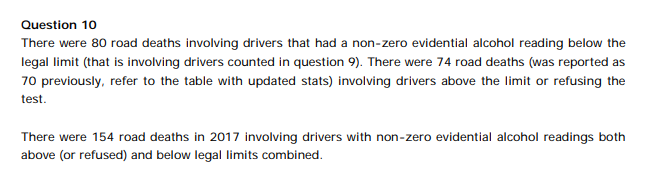
All of these stories were, in Trumpian vernacular, ‘fake news’ – because the AA forgot to ask how many people were killed by drink drivers who were under the legal limit in addition to those who were over it. So I asked NZTA the question. They then disclosed that, in fact, 154 people were killed by drink drivers in 2017. This is almost double the number killed in drug-related accidents. See the NZTA’s response to one of my questions below:

Question 10
Answer by NZTA to OIA question: how many people were killed by drink drivers who were under the legal limit in 2017?

The AA used their dodgy data about drug deaths to argue that police should be given saliva testing kits to tackle what they called this ‘silent killer’. A spokesperson for the AA, was quoted as saying:

“The AA has called drugged driving a silent killer on our roads for years and these latest figures confirm how prevalent drugs are in fatal crashes.”

There is no doubt that the number of deaths on the road related to drug use is rising. However, it is still nowhere near the number killed by drink-drivers.

Remarkably, the figures also show that slightly more people were killed by drink drivers under the legal limit (80) than were killed by drivers over the limit (74). What this suggests is that the decision to lower the legal limit from 400 micrograms of alcohol per litre of breath to 250 micrograms in 2014 has had no impact on the road toll – which, in fact, has been going up for the last six years (see chart).

Road deaths
Alcohol & drug use contributes to over half of all road deaths

In 2017, 154 alcohol related deaths plus 79 drug related deaths suggests a total of 233 people were killed by drivers under the influence of alcohol or drugs. Deducting 21 cases where the driver was under the influence of both alcohol and drugs, that’s 212 or 56% of all road deaths that year. Because the AA has been misinterpreting the data for years, it mistakenly claims on its website that alcohol and drugs contribute to only one third of deaths on New Zealand roads.

A zero solution

This leads to an obvious, but politically unpalatable, policy recommendation. If we want to cut the road toll, we need to cut the legal limit for adults to zero – just as we did for teenagers in 2011. This might seem radical but the idea is even supported by those who make a habit of drink driving. At the Make A Plan (MAP) programme for repeat drink drivers in Wellington, participants are asked why they chose to drive after they had been drinking. Often they say: “I thought I was alright to drive”.

In other words, although they had been drinking, they didn’t feel drunk; they were unable to judge whether or not their drinking may have put them over the limit. Participants generally agree that if the limit was zero, the situation would be crystal clear and it would be much easier to make the decision – one drink and they would not be allowed to drive.

Obviously, this would not stop everyone. There are plenty of ‘bloody idiots’ who just don’t care. But for the generally law-abiding citizens among us, legal clarity is helpful. If you intend to go drinking, don’t drive. Such a move would demonstrate the Government was serious about the audacious target of zero deaths on New Zealand roads set by Julie Anne Genter in April 2018. Remarkably, in January 2019 Ms Genter changed tack 180 degrees and said it would be many decades before the road toll would be significantly reduced. It seems like she’s given up.

I know something that might help. Reduce the legal limit to zero. Any road safety strategy with a higher than zero alcohol limit has zero hope of achieving zero road deaths.

Public reaction to murder of Grace Millane racist, sexist & politically dangerous

Grace Millane

New Zealanders like their murder victims to be young, attractive, female – and white. When they are, we make a real fuss. Look at the publicity currently generated by the murder of 18-year-old Christie Marceau in 2011 and 22-year-old British backpacker, Grace Millane, just two weeks ago. Here’s just a few of the recent headlines: Grace’s legacy – Prominent women challenge men and Govt and Senseless killing’ – Grace’s death was like my daughters.

Prime Minister, Jacinda Ardern, felt it necessary to make a national apology claiming All New Zealanders ‘will feel heartbreak for that family’. The Guardian summed it up claiming that Grace Millane murder prompts outpouring of grief in New Zealand.  

‘Missing white woman syndrome’

It’s intense. Writing on Stuff, Alison Mau pointed out that ‘plentiful pictures of gorgeous Grace were available’ in this plethora of publicity and implied that all this attention is inherently racist. She noted that social scientists call it ‘Missing White Woman Syndrome’ defined by…

“the media’s undue focus on upper-middle-class white women who disappear, with the disproportionate degree of coverage they receive being compared to cases of missing men or boys, women of colour, and women of lower social classes.”

Mau reports that in Western countries like New Zealand, numerous studies reveal “viewers will stay glued to the set to hear endlessly about young, photogenic missing women – but only if they’re white” and can be depicted as “innocent” and “angelic”.

Mau makes the point that Grace is the 15th woman to be murdered in New Zealand this year.  But none of the other murders acquired anywhere near the same amount of attention – bearing in mind 31% of homicide victims are Maori and 62% of victims are male.  Paul Little argued in Grace Millane case highlights a terrible double standard that:

“Grace Millane and her memory deserve every tribute, and her whānau deserve every iota of sympathy that comes their way. But so did those other victims… we act as though all lives aren’t created equal.”

Christie
Christie Marceau – innocent & angelic

The murder of Christie Marceau

The media’s response to the murder of Christie Marceau was equally intense. She was also young, attractive, female and white. Christie was killed by Ashkay Chand who two months earlier had already threatened to rape and kill her. Much of the subsequent outrage, driven by Garth McVicar, was directed at the judge who allowed Chand out of prison on bail. McVicar even started a campaign to have the bail laws amended so this would never happen again.

Sure enough, two years later, National passed the Bail Amendment Act which doubled the number of prisoners on remand in three years and created a crisis in prison capacity. In response, Justice Minister, Andrew Little, said Labour wanted to reduce the prison population by 30%.

One of the concerns about the Grace Millane case is that Google and British media breached the temporary suppression order and named the alleged perpetrator. Peter Williams claimed the internet has compromised justice and wondered whether he can get a fair trial. Williams also found it totally inappropriate that the Prime Minister made a public apology to the Millane family. He wrote:

“Has a New Zealand political leader ever made such an emotional comment about a homicide victim before? More pertinently, why would the Prime Minister think it appropriate to comment on one homicide victim in a week when there were at least three other homicides in the country? Politicising a homicide case is not appropriate. Do it for one, and you really should do it for all.”

And not just for the families of attractive, young, white females. Each year approximately 50 people are murdered in New Zealand – giving us one of the lowest homicide rates in the world. No one in the Government has ever apologised to any of these families – not even to the family of Christie Marceau where a judge was (incorrectly) accused of being at fault.

Media commentator, Jim Tucker, thinks the outpouring of outrage is because Grace’s murder has embarrassed us overseas.  It seems we’re so embarrassed that a …

“cohort of prominent women including former Prime Ministers Helen Clarke and Jenny Shipley signed an open letter to the men and government of New Zealand and submitted it to the Prime Minister’s office. The letter stated that New Zealand had some of the worst statistics for violence against women in the OECD and listed actions each party could take to make our country a safer place.”

Of course, different countries define and report violence using a variety of methodologies so it is not clear how reliable these statistics actually are. Nevertheless, in yet another headline, the Government says it is listening’.

That’s a worry. Ever since the law and order referendum initiated by Norm Withers in 1999, New Zealand has been listening to populists with a penchant for punitive legislation. Just this year, a Bill was introduced requiring judges to impose a six-month prison sentence on anyone who attacks a paramedic or other first responder. At the beginning of December, new legislation came into effect penalising attempted strangulation. Both of these will put more people in prison.

Why is this politically dangerous?

It’s dangerous because it risks escalating the pathetic competition between political parties to be tough on crime which has gone on for the last 20 years – and because it will undermine Andrew Little’s aborted attempts to reduce the prison population.

So how will politicians respond to the murder of Grace Millane? Chances are some right-wing MP will try to re-introduce a private member’s Bill advocating the death penalty for the murder of attractive, young, white women. Further down the track, some other MPs could decide to hang the killers of less attractive, young, white women – or even wrinkled, older, white women. That would keep the prison population down.

Gavin Hawthorn: sending him to prison does not make us any safer

Gavin.png
Gavin Hawthorn: 13 convictions for drink driving

News that Gavin Hawthorn has recently been convicted of drink driving yet again has caused oodles of outrage in the media. Hawthorn has already killed four people in two separate accidents. In 2004 he was convicted of manslaughter over the death of his friend Lance Fryer and sentenced to 10 years in prison. He was released in 2013 and has now been caught drink-driving again – for the 13th time. On this occasion Judge Johnston sentenced him to six months home detention and disqualified him from driving for two years.

The headlines were horrified. Stuff stated it like this: Recidivist drink-driver Gavin Hawthorn convicted again, leading to call for permanent driving ban. Newshub harrumphed that it was ‘Appalling’: Porirua man Gavin Hawthorn escapes jail after 12th drink-driving conviction. The Herald highlighted: NZ’s worst drink driver caught drunk behind the wheel again. Duncan Garner was especially incensed arguing that:

“This judge has failed to keep us safe as New Zealanders. We’ve been let down by his profession once again. He has let us down, now we are in harm’s way.” He went on to say the case was an example of why the public “have little confidence in the justice system”.

Blaming judges is misguided and myopic.  This is what Garth McVicar and the senseless sentencing trust have been doing for years. All that has achieved is a burgeoning prison population and a crisis in capacity. At $100,000 per prisoner, per year and a reoffending rate of 60% within two years of release, clearly this is a failed strategy – and a massive waste of taxpayer money.

Keeping us safe

The justification for all this moral outrage is the dubious assumption that sending ‘dangerous’ people to prison ‘keeps us safe’. Does it? Let’s look at the facts.

Gavin Hawthorn killed his last victim in 2003. Between 2003 and 2017, another 5,402 people have died on New Zealand roads – an average of 360 people a year – or nearly one every day. Half of these deaths are caused by drivers under the influence of alcohol or drugs, or both.

The point is that most of these people died during the ten years that Hawthorn was in prison. Clearly his incarceration did not make us any safer. Giving the judge a hard time for not sending him to prison on his current conviction does not change this reality.

So, what’s the solution? The only intelligent comments in the media came from Andrew Dickens on NewstalkZB who asked rather quaintly: What to do with our drinkiest drink driver?  He argued with considerable insight that:

“Indefinite incarceration and licence deprivation is not what this man needs. What he needs is to STOP FREAKING DRINKING.”

Drug courts

Dickens’ answer to the problems posed by the likes of Gavin Hawthorn is to put him into a drug court (in New Zealand known as AODTC – Alcohol and Other Drug Treatment Courts). To be eligible, defendants must be alcohol or drug dependent and facing a prison sentence. A treatment plan for each participant is developed by the judge, taking into account the views of treatment providers, support workers and lawyers; it involves rehabilitation, counselling, drug-testing, community service and making amends to victims.

Dickens describes the process like this:

“They’re a three-phase, 18-month-long programme designed for high-needs and high-risk addicts who are facing prison, or who have tried but failed treatment programmes in the past.”

Drug courts have the potential to help thousands of offenders, not just drink drivers. And there is no shortage of available candidates in New Zealand. In 2011, judges told the Law Commission that 80% of all offending was alcohol and drug related. In 2017, Northland district court  judge, Greg Davis, who sees a lot of methamphetamine related crime, said up to 90% of all offending was related to issues with addiction.

Currently, the only two drug courts in the country are both in Auckland. Hawthorn is serving his sentence of Home Detention in Paraparaumu – so a drug court in Wellington would be helpful. We need such courts in all our major cities.

Compulsory AOD assessment

Another strategy is available to target drink drivers in particular – one that also involves assessment and treatment. Currently out of 20,000 people convicted of this offence each year, only 5% – those disqualified indefinitely – are required to have an alcohol and drug assessment to see if they have their drinking under control before getting their driver’s licence back. Many of the remainder are sent to prison – just like Gavin Hawthorn. If any drink driver who incurred a second conviction was required by law to have an AOD assessment before their disqualification could be lifted, fully half of the 20,000 drink drivers would be assessed. As a result, there would be a lot less people in prison.

An evaluation of the NZ drug courts shows they also reduce imprisonment – 282 participants have been kept out of prison during the six years the two Auckland courts have been operating.

So if the government implemented these two strategies, this would shift the focus of our justice system away from punishing alcohol and drug addicted offenders towards treating them instead.  This would surely help Justice Minister, Andrew Little, get closer to the Government goal of reducing the prison population by 30%. Maybe it would even moderate the media to tone down their moral outrage.